How to Translate Business Documents (Accurate & Professional Guide)
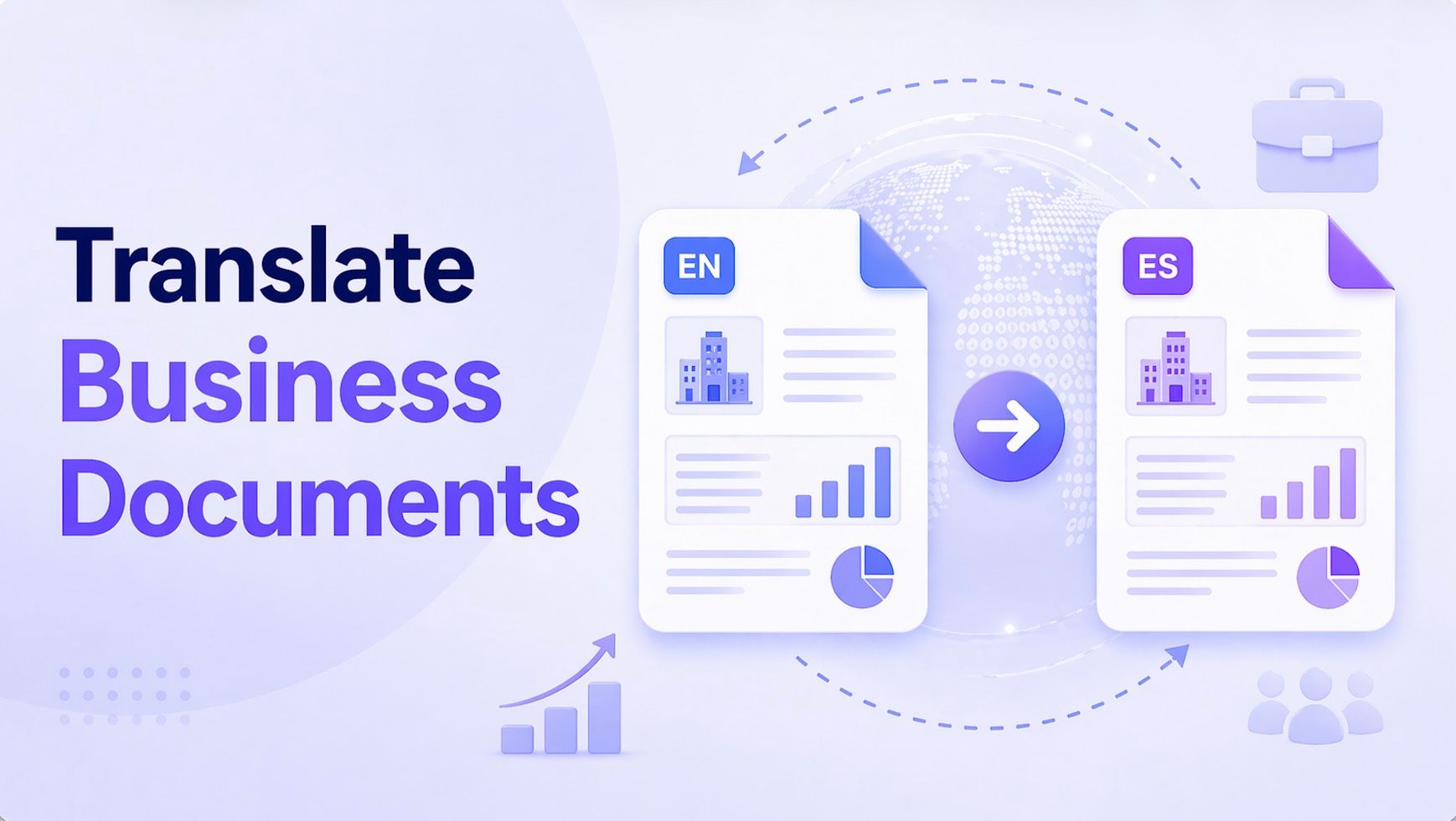
In today’s global market, a poorly translated document isn't just awkward—it's a liability. A single misinterpreted clause in a contract can derail a partnership, and a clumsy marketing slogan can sink a product launch. The best way to translate business documents is to match the method to the document's purpose. For internal communications and initial drafts where speed is paramount, a secure AI tool is your best bet. For legally binding contracts and high-stakes client materials, professional human translators are non-negotiable. For most other needs, a hybrid workflow that combines AI's efficiency with human review offers the ideal balance of speed, cost, and quality.

This guide is your playbook for making that choice. We'll break down the methods, tools, and pitfalls to help you build a smart, scalable translation strategy that protects your brand and your bottom line.
Quick Verdict: Choosing Your Business Document Translation Method
For busy professionals, choosing the right translation path can feel overwhelming. This table cuts through the noise, giving you a clear snapshot of your options. Use it to make a quick, informed decision based on your specific needs.
| Method | Best For | Speed (Typical Turnaround) | Accuracy Level (Editorial Score) | Cost Tier |
|---|---|---|---|---|
| AI-Powered Tools | Internal reports, emails, draft versions, large-volume content | Minutes to < 1 Hour | 4/5 (Good for Gist & Internal Use) | $ (Low / Free) |
| Professional Human Service | Legal contracts, financial statements, public-facing marketing | Hours to Several Days | 5/5 (Publication-Ready & Certified) | $$$ (High) |
| Hybrid Workflow (AI + Human) | Client proposals, presentations, websites, important reports | 1-2 Business Days | 4.5/5 (Reviewed & Polished) | $$ (Medium) |
Scores are editorial heuristics based on typical outcomes, not measured benchmarks. Accuracy for AI varies widely by language pair and source quality.
The takeaway is simple: if you need a fast, low-cost translation of an internal PowerPoint deck, an AI tool is your champion. If you're signing a multi-million dollar deal, invest in a professional human service. For everything in between, the hybrid approach delivers the best value.
The 3 Core Methods for Business Document Translation Explained
Understanding the engine behind each translation method is key to choosing wisely. Let's unpack the pros, cons, and ideal use cases for each.
1. AI-Powered Translators (The Scalability Engine)
Modern AI translators run on sophisticated Neural Machine Translation (NMT) models, which have become remarkably good at understanding context and grammar. They are the workhorses of the translation world, built for speed and volume.
- Pros:
- Incredible Speed: Translate a 50-page report in under a minute.
- Cost-Effective: Often free or available at a low subscription cost.
- 24/7 Availability: No need to wait for business hours or freelancer availability.
- Broad Language Support: Tools like Lynote cover over 135 languages.
- Cons:
- Lack of Nuance: AI can miss cultural idioms, sarcasm, or brand-specific tone.
- Potential for "Literal" Errors: It may translate words perfectly but miss the underlying meaning, which is dangerous in legal or technical contexts.
- Inconsistent with Ambiguity: A poorly written source document will almost always result in a poor translation.
Best for: Internal communications, getting the gist of a competitor's report, creating a first draft for a human to refine, and handling large volumes of user-generated content.
2. Professional Human Translation (The Accuracy Standard)
This is the gold standard for quality. A professional translator isn't just bilingual; they are a skilled writer, a subject-matter expert, and a cultural consultant rolled into one.
- Pros:
- Highest Accuracy: Essential for legal, medical, and financial documents where precision is paramount.
- Cultural Adaptation (Localization): A human can adapt marketing copy to resonate with a local audience, not just translate it.
- Handles Complexity: They can navigate ambiguity, creative language, and industry-specific jargon.
- Cons:
- High Cost: Billed per word, rates can range from $0.10 to $0.30 or more.
- Slow Turnaround: A human translator can typically handle around 2,000 words per day.
- Limited Scalability: Not feasible for translating thousands of documents on a tight deadline.
Best for: Final versions of contracts, court documents, annual financial reports, high-profile marketing campaigns, and any document where errors carry significant risk.
3. Hybrid Workflows (The Modern Best-of-Both-Worlds)
The smartest businesses don't see this as an "either/or" choice. A hybrid workflow, often called Machine Translation Post-Editing (MTPE), uses AI for the initial heavy lifting and a human expert for the crucial final review.
This process often involves Computer-Assisted Translation (CAT) tools, which are different from pure AI translators. CAT tools provide a professional translator with a suite of features like **Translation Memory (TM)**—a database that stores previously approved translations. If you translate "Board of Directors" once, the TM ensures it's translated the same way across all future documents, guaranteeing consistency.
- Pros:
- Balanced Cost and Speed: Faster and cheaper than a full human translation.
- High Quality: Achieves near-human levels of accuracy after the review stage.
- Excellent Consistency: Leverages TM and glossaries to maintain brand voice.
- Cons:
- Requires Management: You need a process to manage the workflow between the AI tool and the human reviewer.
- Dependent on AI Quality: The better the initial AI draft, the faster and cheaper the human review.
Best for: The majority of business documents—client presentations, website content, technical manuals, and important internal reports that need to be polished and professional.
How to Get Fast, Secure Document Translations with an AI Tool
When you need to translate a report for an internal meeting tomorrow or get a quick understanding of a partner's proposal, a fast business document translation online service is indispensable. Here’s a practical walkthrough using a tool designed for this exact purpose.
Before you start:
- Check File Size: Ensure your document is under the tool's limit (e.g., 10 MB for Lynote's on-page translator).
- Use a Supported Format: Have your file ready in a common format like PDF, DOCX, PPTX, or XLSX.
- Optimize Scans: For scanned documents, make sure the text is clear, high-contrast, and free of heavy shadows or scribbles for the best OCR results.
- Remove Passwords: The document must not be password-protected.
Step 1. Upload Your Business Document
First, navigate to the Lynote Document Translator. You'll be greeted by a clean, straightforward interface without any required sign-ups or logins. You can either drag your file directly into the upload box or click the “Choose Document” button to browse your computer. This immediate access is a huge time-saver when you're on a deadline.

Step 2. Select Languages and Translate
Once your file is uploaded, the tool's intelligence kicks in. The source language is typically auto-detected, saving you a step. Your main job is to select the target language from the extensive dropdown menu, which includes over 135 options. After making your selection, click the translate button. Powered by Google's advanced neural translation engine, the process is incredibly fast—a multi-page document is often ready in seconds.

Step 3. Download the Translated File
This is the moment of truth where many free tools fall short. Once Lynote finishes processing, a download link will appear. The file you receive isn't just a wall of translated text; it’s a fully formatted document. The main reason Lynote outperforms basic copy-paste translators for business use is its powerful layout preservation engine. Your fonts, images, tables, and paragraph alignment are kept intact, saving you the tedious and time-consuming task of rebuilding the document from scratch.

Expert Takeaway: Layout preservation is a non-negotiable feature for business documents. A translated PowerPoint deck that loses its charts and branding is useless. Prioritize tools that maintain the original file's integrity.
Beyond Words: Key Factors for Professional-Grade Translation
A successful translation goes far beyond simple word replacement. Here are the critical details that separate amateur efforts from professional results.
The Challenge of Scanned PDFs and OCR
You've just been handed a 20-page contract from a partner, but it's a scanned PDF—essentially an image of text. How do you translate it? This is where Optical Character Recognition (OCR) technology comes in. OCR scans the image, identifies the letters and words, and converts them into machine-readable text that an AI can then translate.
Modern tools like Lynote have built-in OCR, but its effectiveness hinges on the quality of the scan. A clean, high-resolution scan will yield great results. A blurry, low-contrast scan with handwritten notes in the margins will struggle, potentially leading to gibberish. Always start with the best quality source document possible.
Terminology Consistency: Your Brand's Single Source of Truth
Does your company call its clients "customers," "partners," or "users"? In a single document, it might not matter, but across hundreds of documents translated by different people, inconsistencies erode brand voice and create confusion.
Professionals solve this by creating a glossary or termbase—a master list of approved translations for key business terms. While most standalone AI tools don't manage glossaries, this is a crucial step in a hybrid workflow. After generating a draft with an AI tool, your human reviewer should check it against your glossary to ensure terms like "Annual Recurring Revenue" are translated consistently every single time.
Localization vs. Translation: Speaking the Culture, Not Just the Language
The biggest mistake in translating marketing materials is aiming for a literal, word-for-word conversion. Effective cross-border communication requires localization—adapting the content's message, tone, and imagery to fit the target culture.
A classic example is a marketing slogan that relies on a pun or a cultural reference in English. A direct translation will fall flat or, worse, be nonsensical. A human translator or a localization expert will instead create a new slogan that evokes the same feeling and brand message for the local audience. AI is great for a first pass, but localization requires human creativity and cultural intelligence.
Tailoring Your Approach: A Guide for Different Business Document Types
Not all business documents are created equal. The risk, audience, and purpose should dictate your translation strategy.
- High-Risk Legal Contracts:
- Method: Professional human translation is mandatory. Use a translator with certified legal expertise in both jurisdictions.
- Workflow: Never rely on AI for the final version. You can use it for a preliminary read-through to get the gist, but the official translation must be handled by an expert who understands the legal implications of every clause.
- Data-Heavy Financial Reports:
- Method: Hybrid workflow is ideal.
- Workflow: Use an AI tool that excels at preserving tables and formatting, like Lynote. The initial translation will handle the bulk of the text. Then, have a financial expert or professional translator meticulously review all figures, charts, and terminology to ensure 100% numerical and contextual accuracy.
- Brand-Sensitive Marketing Materials:
- Method: Hybrid workflow with a focus on localization.
- Workflow: Start with an AI translation to get the basic content across. Then, hand it over to a marketing-savvy native speaker. Their job isn't just to proofread; it's to rewrite copy, adapt slogans, and ensure the brand voice resonates culturally.
- Time-Sensitive Internal Emails & Memos:
- Method: AI-powered translation is the clear winner.
- Workflow: For day-to-day internal communication, speed and clarity are more important than perfect prose. A secure, no-signup tool is perfect for quickly translating an email from a global colleague or a company-wide announcement. The goal is comprehension, not publication.
Common Pitfalls to Avoid in Business Document Translation
Even with the best tools, it's easy to make costly mistakes. Here are the most common traps and how to sidestep them.
- Using Non-Secure Public Tools for Confidential Data. That free, ad-supported website you found through a quick search might be a terrible choice for your company's financial projections or M&A strategy. Many free services reserve the right to use your data to train their AI models. Always opt for a business document translator that explicitly states its security policy, such as using SSL encryption and deleting your files from their servers after processing.
- Skipping the Human Review for Client-Facing Documents. You've used a great AI tool and the translation looks clean. It's tempting to send that proposal directly to a potential client. Don't. A small, awkward phrasing or a mistranslated industry term can instantly undermine your credibility. For any external document, a quick review by a native speaker is a small investment that pays huge dividends in professionalism.
- Underestimating the Complexity of Formatted Files. Translating a plain text file is easy. Translating a 50-slide PowerPoint presentation with custom fonts, embedded charts from Excel, and complex animations is another beast entirely. Text expansion (e.g., German is often longer than English) can break layouts. The ugly truth is that even with the best layout-preserving tools, you should budget time for a final design review to fix any text overflows or misaligned elements.
Frequently Asked Questions
How do you translate business documents accurately?
True accuracy comes from a multi-layered approach. Start with a high-quality source document, use a reliable translation engine (AI or human), enforce terminology consistency with a glossary, and conduct a final review with a native speaker who understands the subject matter.
What is the best way to translate business documents?
For most businesses, a hybrid workflow is the best overall approach. It combines the speed and cost-efficiency of AI translation for the initial draft with the nuance and accuracy of a human review for the final polish. This balances quality, cost, and turnaround time effectively.
Can AI translate business documents professionally?
Yes, but with a crucial caveat. AI is excellent at producing a professional-quality draft. For internal use, this is often sufficient. For official or client-facing documents, that AI-generated draft should always be considered the first step, to be finalized by a human expert.
Why did the formatting of my PDF change after translation?
This usually happens for two reasons. First, the PDF might be a scanned image, and the OCR process couldn't perfectly replicate the layout. Second, text length changes during translation—a sentence that fits on one line in English might need two lines in Spanish, causing text to reflow and push other elements around. Using a tool with strong layout preservation minimizes this, but some manual adjustment is sometimes unavoidable.
How much does business document translation cost?
Costs vary dramatically. AI tools are very low-cost, often free for limited use. Professional human translators can charge anywhere from $0.10 to over $0.30 per word, meaning a 5,000-word document could cost $500–$1,500. A hybrid approach falls in the middle, as the human editor is paid for their time, not for translating from scratch.
Conclusion: Your Path to a Smarter Translation Workflow
Translating business documents is no longer a simple choice between slow, expensive humans and fast, flawed machines. The modern landscape offers a spectrum of solutions, and the smartest strategy is knowing which one to deploy for the job at hand.
For the vast majority of day-to-day business needs, the path forward is clear:
- Leverage AI for Speed: Use a secure, efficient tool for the first pass on all but the most critical legal documents.
- Establish Consistency: Create and maintain a simple glossary of your core business terms.
- Implement Human Review: For any document that will be seen by clients, partners, or the public, invest in a final review by a native speaker.
This pragmatic, tiered approach saves money, accelerates timelines, and protects your company’s professional image on the global stage.
Editor's Choice: A Hybrid Workflow Powered by a Secure AI Tool
For the best balance of performance and value, we recommend a hybrid workflow. Start with a fast business document translation online service like the Lynote Document Translator to handle the initial, time-consuming work while preserving your document’s format. Then, layer on a targeted human review for critical nuance and polish. This method gives you the scalability of AI without sacrificing the quality your business deserves.