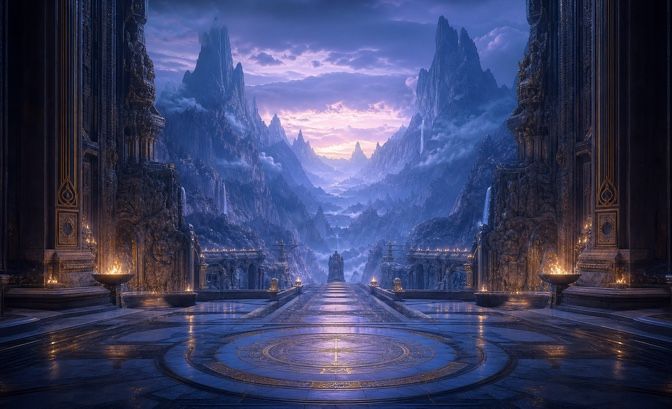
Polished Style Without a Clear Source
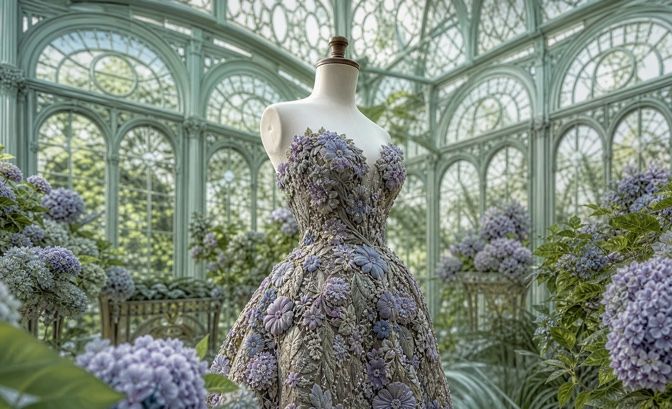
The image may look production-ready, yet have no photographer, original post, project file, or creation history that explains where it came from.

Drag & drop or upload an image
JPG · JPEG · PNG · WEBP · max 10 MB
Detected then deleted · Reports are independently verifiable
Upload an image to start
Drop a file on the left, or pick one of the sample images.
Try one of our sample images
Uncover the truth behind any text. Use our free AI detector to instantly analyze and verify whether content is human-written or AI-generated.


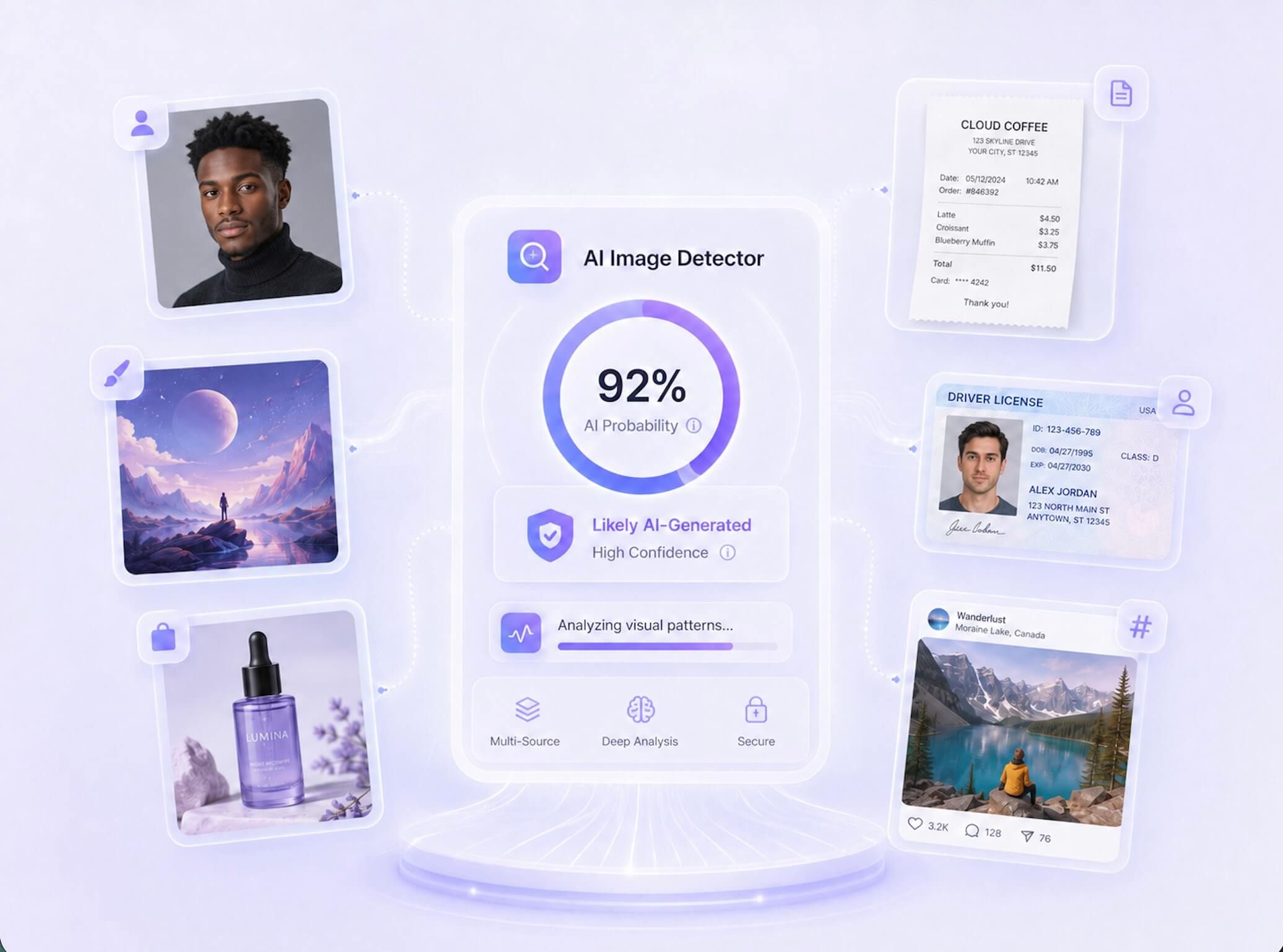
Upload the portrait, artwork, product visual, or social media post you suspect was generated with Midjourney. We support standard formats including JPG, JPEG, PNG, WebP, and HEIC files.

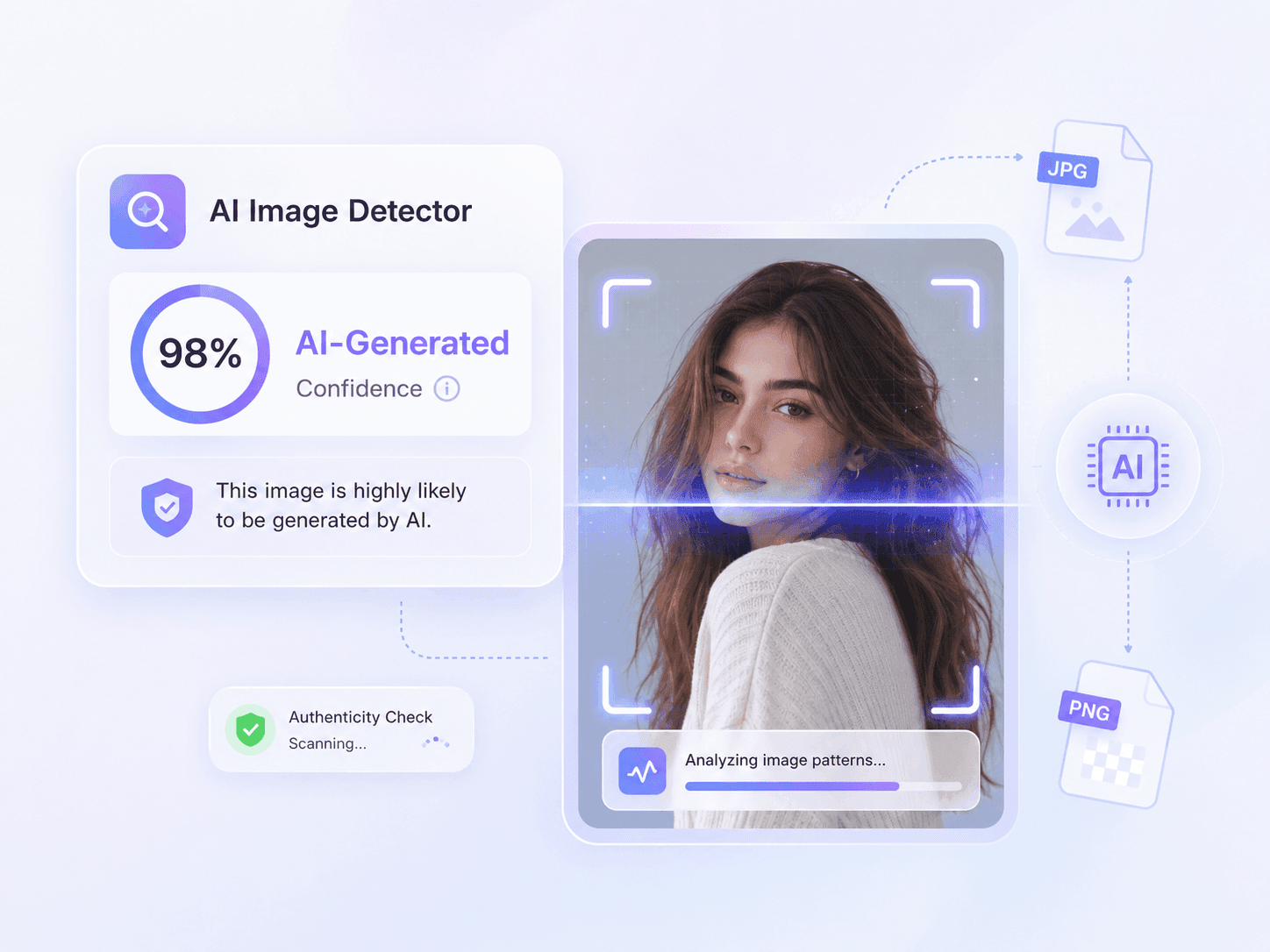
Click the 'Detect Image' button to start the analysis. Lynote checks the suspected Midjourney image for visual patterns and available file signals.

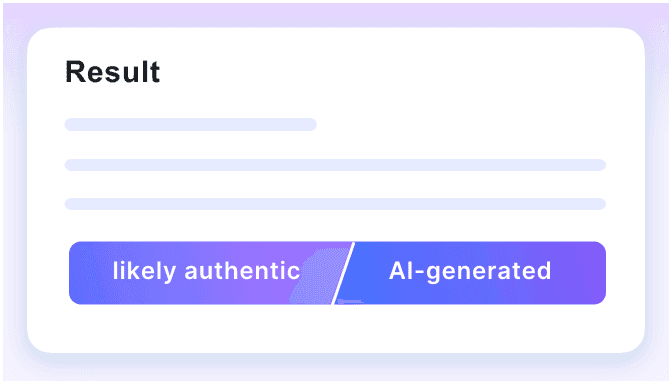
Read the AI and human probability signals to see how strongly the image leans. If the result points toward AI, check the original source, creator history, or project files before making a final decision.
Midjourney does not leave one universal visual fingerprint. These patterns can help you decide when an image deserves a closer source check, but no single sign proves that Midjourney created it.
The image may look production-ready, yet have no photographer, original post, project file, or creation history that explains where it came from.

Inspect hands, jewelry, eyewear, tools, labels, and object intersections. Complex details may look convincing separately but conflict when viewed together.

Signs, packaging, interface labels, and decorative lettering may resemble real language while containing malformed characters or inconsistent typography.

Hair, foliage, fabric, crowds, windows, and ornaments may repeat, merge, or change structure across different parts of the scene.

Compare shadow direction, highlights, mirrors, glass, and reflected objects. A polished subject can still sit inside a scene whose light logic does not hold.

Dramatic depth, symmetry, and color grading can suggest a generated visual when the available metadata and source history do not support a real capture workflow.

Analyze the relationships among textures, lighting, repeated objects, edges, and backgrounds. This supports your review without treating any single artifact as definitive proof.
Available camera or software metadata adds valuable context to your file. Keep in mind that screenshots, social media platforms, and compression often strip these details.
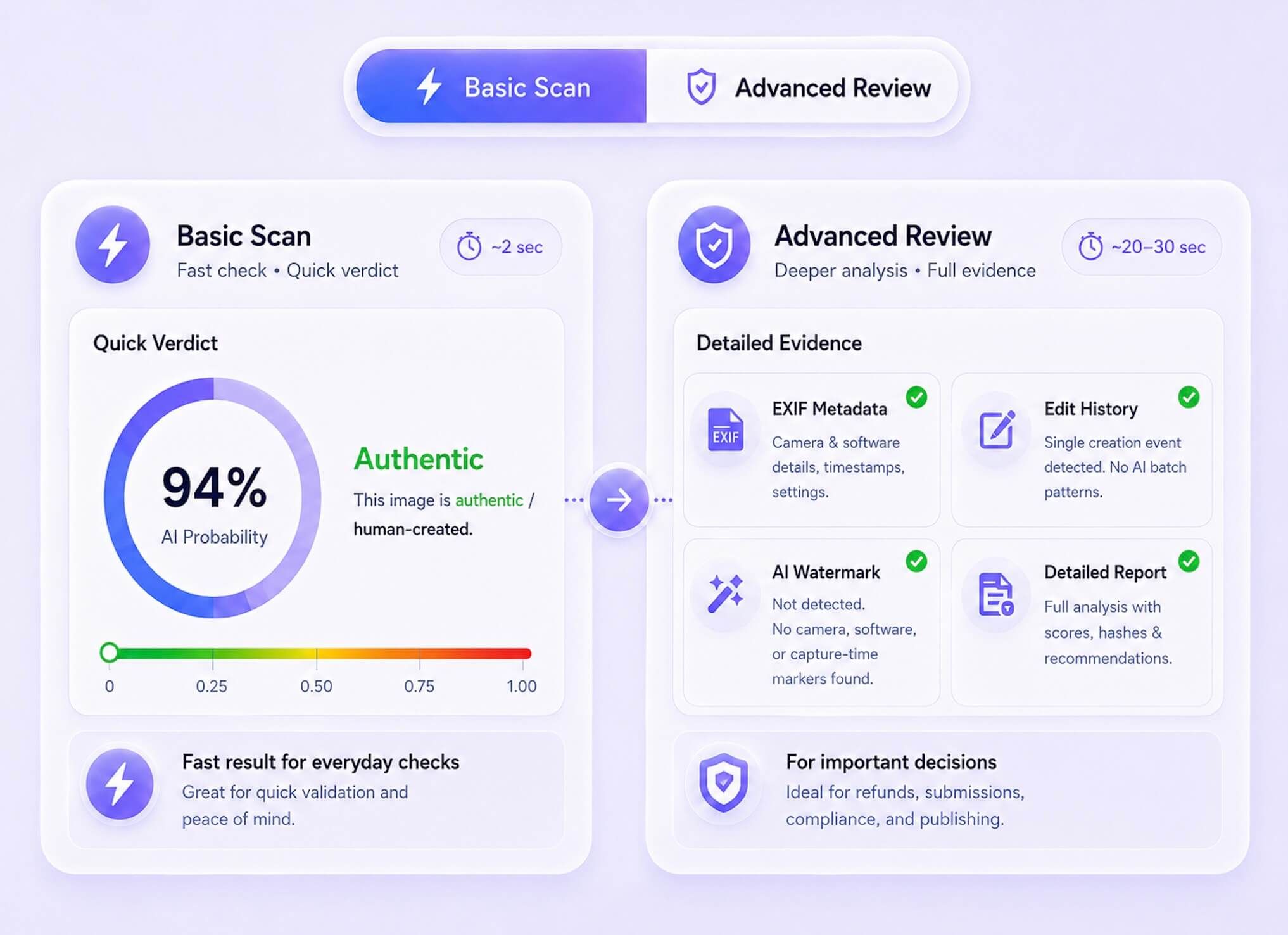
Check available content credentials, file editing history, and embedded watermark evidence. Remember that missing provenance data does not automatically prove an image is real.
Review artwork, portraits, product visuals, and social images specifically when Midjourney use is in question, without relying on a generic style checklist.
Receive a clear probability result showing AI and human likelihoods, offering a practical review signal rather than definitive Midjourney attribution.
Access two review depths: a basic scan for everyday visual screening, and an advanced scan for high-stakes editorial and publishing decisions.
We support practical uploads in JPG, JPEG, PNG, WebP, and HEIC formats. This covers common Midjourney exports, saved web graphics, and standard screenshots.
Your uploads are handled privately during the scanning process. We never store your submitted files or use them to train any machine learning models.

Assess a suspicious news or event image before publication. Verify the original source when the Midjourney image detector flags a high AI probability.

Review portfolio artwork that may be Midjourney-generated. Use the scan as a baseline signal without treating the detector output as absolute proof of authorship.

Flag product photos or digital assets that may use undisclosed Midjourney generation before escalating the listing for further review.

Check viral visuals and user submissions before resharing. Use the result to decide whether the source needs verification or the post should be escalated for review.

Use the report as one part of a fair visual assignment review. Evaluate the results alongside student process files and early design drafts.

Assess commissioned artwork before final approval. Verify deliverables when your project brief restricts generative tools or requires full disclosure of AI usage.
Find answers to common questions about checking images for Midjourney generation.
A Midjourney detector is an online tool that analyzes visual files to estimate the likelihood of artificial generation. It looks past surface-level aesthetics to evaluate pixel patterns, metadata, and structural anomalies, helping you review suspicious artwork and digital assets.
To detect if an image is generated by Midjourney, Lynote reviews visual patterns and any available file context, such as EXIF metadata, content credentials, or watermark signals. It combines the available evidence into AI and human probability results instead of judging the image by style alone.
No, it provides a probability-based review signal rather than definitive legal or academic proof. Modern generative outputs are highly realistic, and false positives can occur. You should use the results to guide further verification, such as requesting original process files.
It can review newer Midjourney images, but increasingly realistic outputs may be harder to distinguish. The result remains a probability signal and does not identify a specific Midjourney version with certainty.
You can upload JPG, JPEG, PNG, WebP, and HEIC files up to 10MB.
Yes. Your files are processed securely for the analysis and are never stored permanently or used to train external AI models.
Yes, the Basic Scan is completely free. We also offer an Advanced Scan for Pro users who need deeper metadata and provenance analysis.
No account is required for the free basic scan. You can upload and check your visual assets immediately.
Modern AI outputs can look convincing and may not contain obvious flaws. Lynote adds visual-pattern analysis and available file-level evidence, such as EXIF metadata or content credentials, while source checking still remains important.
Yes, but results may be less accurate. Compression and screenshotting strip away hidden metadata and alter pixel patterns, making it harder to detect a Midjourney generated image.
The score depends on available metadata, image resolution, and editing history. Original, high-resolution files provide the strongest signals, while cropped, filtered, or heavily altered images lower the tool's overall confidence.
Treat the result as a review signal rather than definitive proof. If the probabilities are close or confidence is limited, check the original source, ask for project files, or run an Advanced Scan.