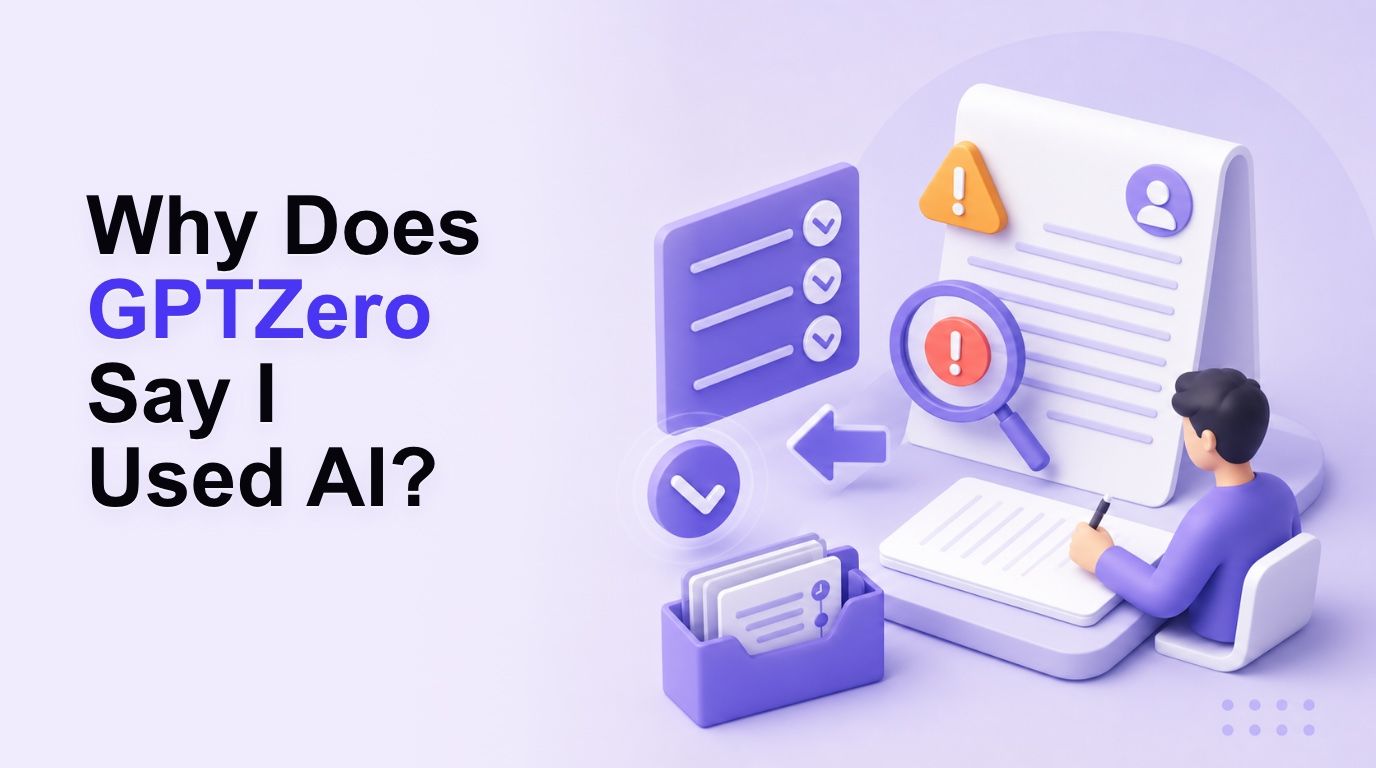
Why Does GPTZero Say I Used AI When I Did Not?
why does gptzero say i used ai when i did not? A GPTZero flag does not automatically mean you used AI. It means your text has patterns the detector associates with AI-generated writing, and those patterns can sometimes appear in careful human writing too.

False positives are especially stressful because the result can feel like an accusation. The best response is to slow down, inspect the highlighted text, and gather evidence of your writing process before making major changes.
Quick Answer
GPTZero may say you used AI because your writing is predictable, polished, generic, repetitive, or too short for confident interpretation. Academic and professional writing can be especially vulnerable because it often uses formal structure and cautious phrasing.
That does not make the score meaningless. It means the score should start a review, not replace one.
Source note: GPTZero explains burstiness and perplexity as only part of a larger detector decision. That matters for false flags because a human draft can look AI-like when it is unusually predictable, polished, short, or formulaic.
Why Human Writing Gets Flagged
Human writers sometimes use patterns that look machine-like. A five-paragraph essay, a generic cover letter, or a highly polished summary can repeat the same rhythm across many sentences.
The detector may also react to broad transitions such as “in addition,” “overall,” and “it is important to note.” Those phrases are not wrong, but too many of them can make the draft feel less specific.
| Possible cause | Why it can look AI-like | What to check |
|---|---|---|
| Short sample | There is not much evidence to analyze | Add more context if appropriate |
| Formulaic essay structure | Paragraphs follow a predictable pattern | Vary transitions and reasoning |
| Generic wording | Claims sound broad or unsourced | Add specific evidence |
| Over-polished tone | Sentences feel evenly smoothed | Restore your natural voice |
| Repeated transitions | The draft has the same rhythm | Rewrite only the repeated lines |

What to Check Before You Panic
Start with the highlighted passages, not the overall score. Ask whether those lines contain real details, source-backed claims, and reasoning that only you could explain.
Then check your writing record. Drafts, outlines, notes, source annotations, document history, and teacher feedback can show how the work developed over time.
How to Respond to a Teacher, Editor, or Client
Stay calm and avoid arguing that the tool is useless. A better response is to explain your process, share drafts or notes if appropriate, and ask which parts of the writing raised concern.
If the flagged text is generic, revise it. Add clearer examples, stronger citations, and more direct reasoning rather than trying to make the score disappear.
Short Response Template if You Were Flagged
If a teacher, editor, or client questions your writing, a calm response is usually better than a defensive one. You can adapt this template:
Thanks for letting me know. I understand why the GPTZero result needs review. I wrote this draft myself and can share my outline, notes, sources, and earlier versions so we can look at the writing process, not just the score. I am also happy to review the highlighted passages and revise any parts that are too generic or unclear.
Do not paste a template blindly. Make it specific to your situation, attach only materials you are comfortable sharing, and keep the focus on evidence.
If the concern comes from a school, ask what review process the instructor wants to follow. Some teachers may want drafts, while others may ask for a short conversation about your sources or argument. A clear process is better than sending ten screenshots without knowing what would actually help.
How to Revise Without Erasing Your Voice
Do not rewrite the whole paper just because a detector flagged it. Work sentence by sentence and keep the parts that already sound like you.
The best revision usually adds specificity. Replace broad claims with sourced evidence, explain why the evidence matters, and use transitions that reflect your actual logic.
Before You Rewrite, Collect Your Process Evidence
If the writing is yours, your process matters. Save or gather outlines, notes, source highlights, earlier drafts, comments from a teacher or editor, and document version history.
This evidence is often more persuasive than a debate about detector accuracy. It shows how the idea developed and gives a reviewer something concrete to discuss.
If you used grammar tools, citation tools, or an AI assistant in an allowed way, be clear about that too. A transparent explanation is usually stronger than trying to make the tool disappear from the story.
Revision Moves That Reduce False-Positive Risk Naturally
The best revisions improve the writing for a human reader. Add specific examples where the draft is broad, explain why each source matters, and replace repeated transitions with logic-based connections.
You can also restore your natural rhythm. If every sentence has the same length and shape, vary the structure and keep a few direct sentences that sound like you.
Do not rewrite only to chase a lower score. Rewrite because the flagged lines are vague, unsupported, or less personal than the rest of the document.
If you used grammar, spelling, translation, or formatting tools, note that clearly in your process record. Those tools can make writing smoother, but smoothing is not the same thing as generating the ideas in the assignment.
If Your Whole Essay Was Flagged
When a detector says most of a document looks AI-like, do not start by rewriting every sentence. First check whether the essay uses the same structure in every paragraph. A repeated pattern can make a human essay look more predictable than it really is.
Next, look for places where the essay makes broad claims without evidence. A sentence such as “this is important for society” may be true, but it can sound generic unless you explain which society, which group, and which evidence supports it.
Finally, compare the essay with your notes. If your notes contain specific ideas that disappeared in the polished draft, bring those details back. A more authentic draft often sounds clearer because it restores the thinking behind the conclusion.
If someone else is reviewing the result, ask which passages matter most. A focused conversation about five highlighted sentences is more productive than arguing about the entire score.
How to Check AI-Like Text With Lynote AI Detector
A detector result should be treated as a review signal, not a final verdict. You can use Lynote AI Detector to check another signal and identify sentences that may need clearer sourcing, more specific examples, or a more natural voice.
Step 1. Paste Text or Upload a Document
Paste the text you want to review, or upload a supported document. For best results, check the final draft rather than an early outline or a very short fragment.

Step 2. Click Detect AI
Run the detector to get a breakdown of AI-generated, mixed, and human-written signals. Use the result to guide review, not to make a final authorship judgment.

Step 3. Review the Highlighted Sentences
Look at the highlighted sentences and decide whether they need clearer sourcing, more specific evidence, or a more natural rhythm. Revise the writing, then check again only if another signal would help.

FAQs About Why Does GPTZero Say I Used AI?
Why does GPTZero say everything is AI?
A whole-document flag can happen when the draft uses the same structure across many paragraphs, relies on generic claims, or gives the detector a short and highly polished sample. Start by checking the highlighted sections.
Can GPTZero be wrong?
Yes. AI detectors can produce false positives and false negatives, especially with short, formal, or formulaic writing. A score should start a review, not end the conversation.
Should I rewrite my whole paper?
Usually, no. Rewrite the parts that are vague, repetitive, unsupported, or unlike your normal voice. Keep strong paragraphs that already show clear reasoning and evidence.
How do I prove I wrote it?
Use drafts, notes, version history, outlines, source annotations, and a calm explanation of your process. Those materials are more meaningful than arguing about a number alone.
Can careful writing look AI-like?
Yes. Careful human writing can look AI-like when it is very polished, highly structured, or written in a generic academic style. Add specificity and preserve your process evidence.
Final Verdict
A GPTZero flag can feel personal, but it is still only a signal. Review the highlighted text, gather writing-process evidence, revise for specificity, and respond calmly if someone questions your work.