

There is no universal acceptable AI percentage for college writing. A result such as 20% or 25% is a detector's estimate, not a school-wide allowance, and it cannot decide by itself whether a student followed the rules.
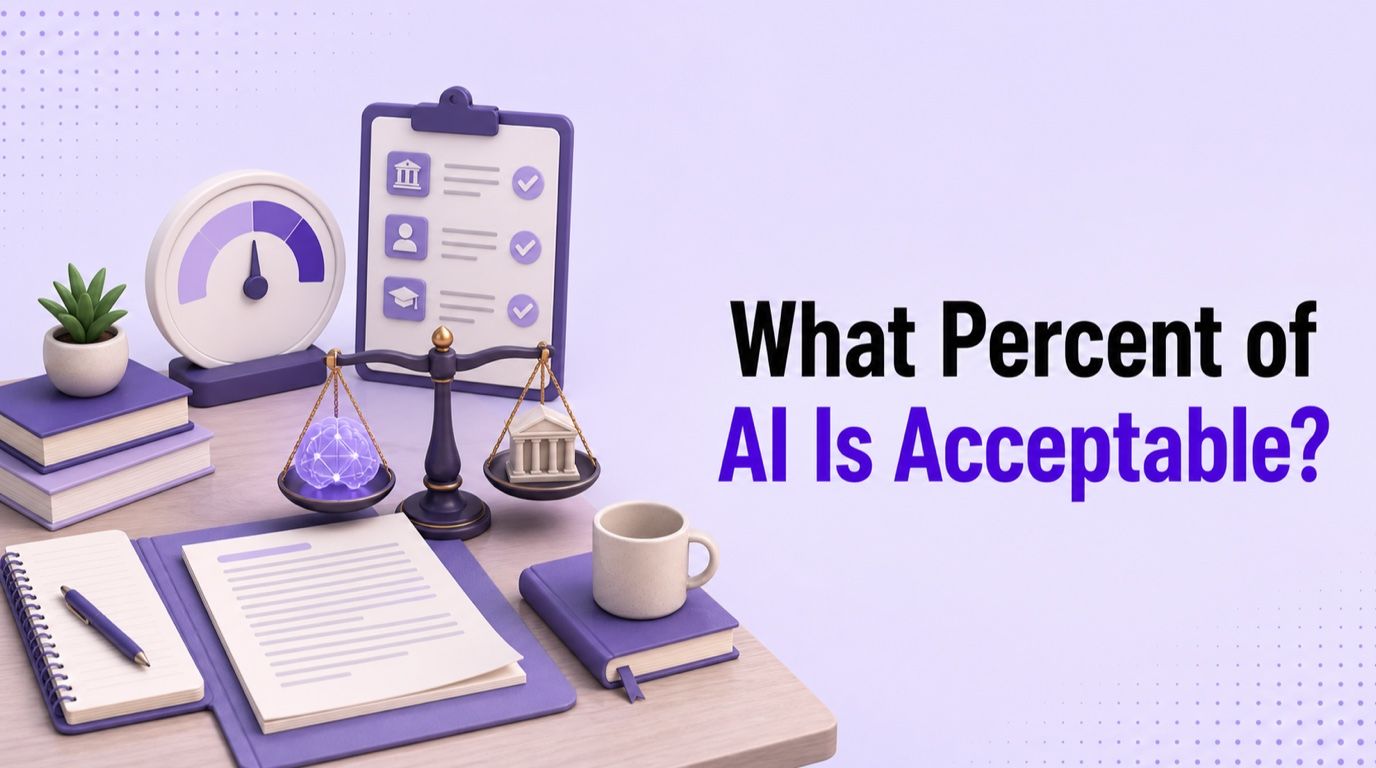
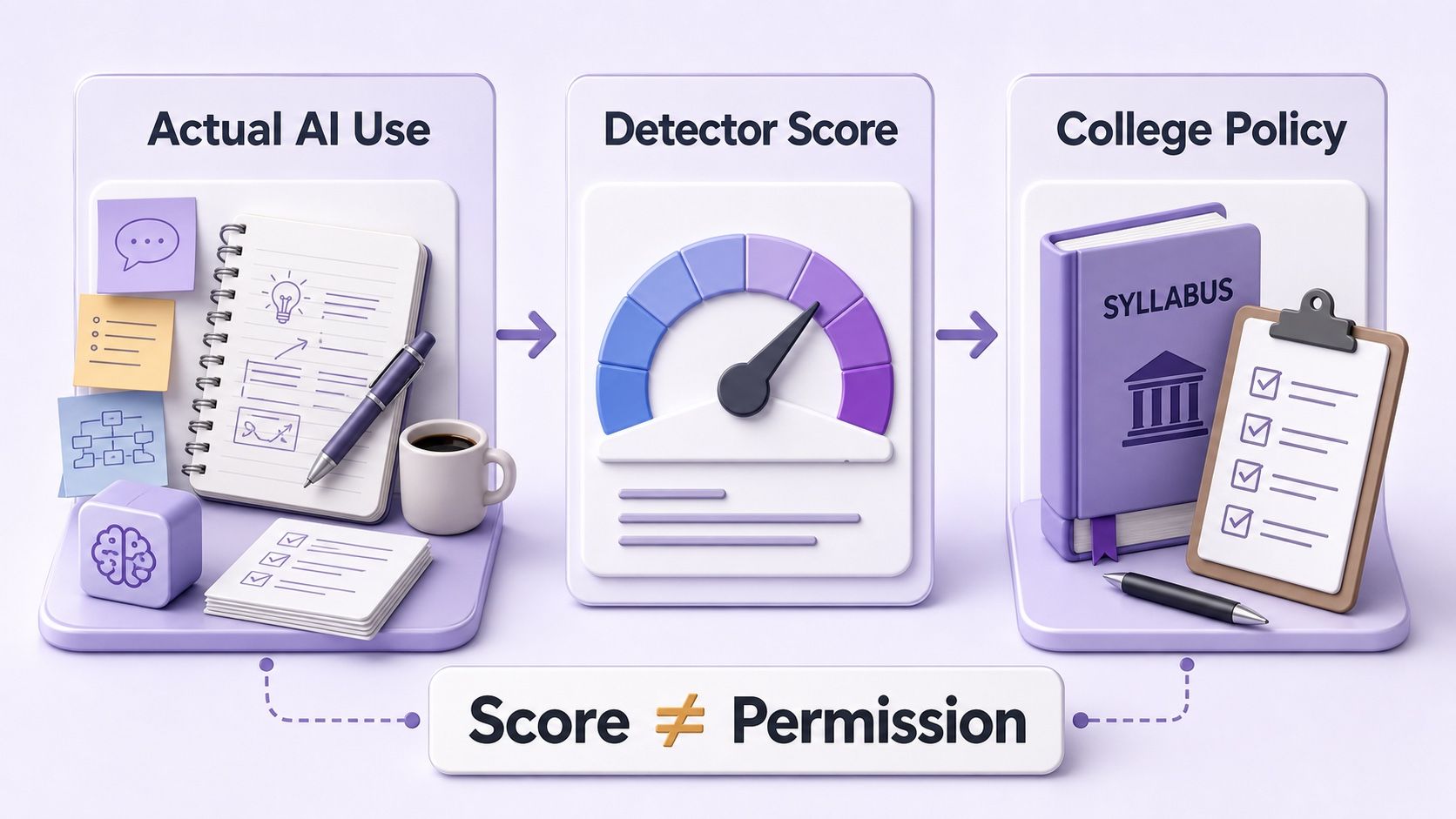
The controlling standard is the policy for the institution, course, instructor, assignment, or application. If AI-generated prose is prohibited, even a small amount may violate the rule; if specific assistance is permitted, disclosure and the student's actual writing process may matter more than a detector score.
That distinction is the most important answer to what percent of AI is acceptable. The number on a report and the amount of AI assistance a policy allows are two different things.
Direct Answer: There Is No Universal Acceptable AI Percentage
No percentage is automatically acceptable across every college or assignment. A 0% result does not prove compliance, while a 20% or 25% result does not prove misconduct.
Policies regulate actions, not detector labels. They may distinguish brainstorming from drafting, proofreading from paraphrasing, or permitted assistance from submitting generated analysis as the student's own work.
| Situation | What determines acceptability? | Does a detector percentage decide? |
|---|---|---|
| Course assignment | Syllabus, assignment instructions, instructor guidance, and institution policy | No |
| College application essay | Application and college authorship rules | No |
| Graduate personal statement | Program and application requirements | No |
| AI-required assignment | The task rubric and disclosure instructions | No |
| Professional or SEO article | Employer, client, publication, and editorial policy | No |
The safest interpretation is policy-first. Find out what type of AI assistance was permitted, compare that rule with what actually happened, and use the detector report only as one piece of context.
Five Different Things People Mean by “AI Percentage”
The phrase “AI percentage” sounds precise, but people use it to describe several unrelated concepts. Confusing them is how a technical report becomes a false pass-or-fail rule.
| Concept | What it describes | What it does not prove |
|---|---|---|
| Actual AI contribution | Which tasks AI performed during brainstorming, outlining, drafting, editing, or translation | The percentage a detector will display |
| AI detection score | Text patterns a model classifies as likely AI-generated or AI-altered | Who wrote the text or whether the use was permitted |
| Similarity score | Text that matches material in indexed sources or submission databases | Whether the text was written by AI |
| Policy allowance | The AI activities permitted for a particular task | How a detector will classify the final language |
| Disclosure requirement | How the writer must document permitted AI assistance | Whether the underlying assistance was acceptable without disclosure |
Actual AI Use Is a Process Question
Actual AI use asks what the tool did. Did it suggest topics, create an outline, write paragraphs, translate sentences, revise grammar, generate citations, or reorganize an argument?
Those activities are not equivalent. A course may allow spelling feedback but prohibit generated analysis, or permit brainstorming if the student discloses the tool and keeps a record of the process.
An AI Score Is a Model Output
An AI detector does not watch the student write. It examines the submitted language and estimates whether eligible passages resemble patterns associated with machine-generated or machine-altered text.
The score can therefore differ from actual use. Fully human writing can be flagged, and heavily AI-assisted writing can receive a low score.
Similarity Is a Separate Question
Similarity tools compare language against sources and databases. A properly quoted passage can raise a similarity score even when it is correctly cited, while an entirely original AI-generated paragraph may have little textual overlap with existing sources.
This is why a similarity percentage should not be called an AI percentage. The two reports answer different questions.
What an AI Detection Percentage Actually Measures
An AI detection percentage represents the portion of qualifying text a particular model identifies as likely AI-generated or, in some systems, likely AI-generated and later altered by a paraphrasing tool. It is not a direct measurement of authorship.
The denominator also matters. Turnitin, for example, calculates its AI writing percentage from qualifying long-form prose rather than every character in a file. Bullets, tables, code, poetry, scripts, and other non-prose material may not be evaluated in the same way.
Imagine an essay containing 1,500 total words but only 1,200 words that qualify for a detector's analysis. A displayed percentage applies to that qualifying text under that product's method, not necessarily to the entire document in the everyday sense.
Different tools can also produce different results because they use different models, thresholds, supported languages, document requirements, and update schedules. A 12% result in one service and a 35% result in another does not mean the document changed between scans.
A detector percentage cannot establish:
- Who wrote a passage.
- Which tool, if any, was used.
- Whether the assistance was permitted.
- Whether the writer disclosed it correctly.
- Whether the content is factual or original.
- Whether academic misconduct occurred.
It can identify passages worth reviewing. That is a useful but narrower role.
Why Turnitin's 20% Rule Is Not an Allowed-AI Rule
One of the most common misconceptions is that Turnitin “allows” up to 20% AI. It does not set a universal academic permission policy.
Turnitin's current guidance says its testing found a higher incidence of false positives when the detected amount falls between 0% and 19%. To reduce misinterpretation, current reports show an asterisk rather than an exact percentage for results below 20%, and they do not provide the same highlights for that range.
That is a reporting and reliability decision. It does not mean 19% is acceptable, 20% is prohibited, or every institution uses those numbers as disciplinary thresholds.
| Turnitin display | Technical meaning | What it does not mean |
|---|---|---|
| 0% | The model did not identify qualifying text as likely AI-generated or AI-altered | Proof that no AI was used |
| *% | Some qualifying text was identified below 20%, where false positives occur more often | Permission to use up to 19% AI |
| 20% and above | The report displays the portion of qualifying text the model flagged | Automatic proof of misconduct |
| No report | The file, language, format, length, or feature availability may not meet requirements | Proof that the document is human-written |
Turnitin also states that its AI model may misidentify human, AI-generated, and AI-paraphrased text. Its report should not be the sole basis for adverse action against a student.
That official limitation is important in both directions. Students should not treat a low result as permission, and instructors should not treat a high result as a verdict without further review.
Is 20% AI Detection Bad?
A 20% AI detection result is significant enough to examine, but it is not automatically bad, acceptable, or evidence of cheating. It means that one detector classified a meaningful share of its qualifying text under its current model.
Start by asking four questions:
- What passages were highlighted?
- What AI use did the assignment permit?
- How was the document actually produced?
- What drafts, notes, citations, and version history support that process?
Location matters. A formulaic methods description, a standardized disclosure, or a generic introduction may require different interpretation from highlighted analysis that contains ideas the student cannot explain.
If you wrote the work yourself, do not immediately flatten your voice or insert awkward errors to chase a lower result. Preserve the original document and collect evidence of how it developed.
If you used prohibited generated prose, the responsible response is to redo that work according to the assignment rules. Running it through repeated paraphrasing does not repair the underlying authorship problem.
Is 25% AI Detection Bad?
A 25% result deserves careful review for the same reason as 20%, but it is not a universal failure line. The five-point difference does not transform an uncertain model output into proof.
The highlighted content is more informative than the headline number. Twenty-five percent concentrated in repetitive background language presents a different question from generated reasoning spread through the central argument.
The policy still controls. A course that permits documented AI editing may evaluate the process differently from a course that explicitly prohibits generated wording, even if both papers receive the same detector result.
Students and instructors should therefore avoid percentage-only conclusions such as:
- “Anything under 30% is fine.”
- “Any score above 20% is misconduct.”
- “A 0% score proves the paper is original.”
- “A 25% score means one-quarter of the student did not write the essay.”
None of those statements follows reliably from the score alone.
How Much AI Is Acceptable in a College Essay?
The phrase “college essay” can mean a class assignment or an admissions essay. These contexts have different purposes and may have very different rules.
Course Assignments
For coursework, acceptable use may be prohibited, limited, permitted with disclosure, or explicitly required. The same student can encounter all four approaches in one semester because instructors design assignments around different learning outcomes.
A grammar correction may be allowed in one class while AI-assisted rewriting is prohibited in another. A computer science course may require students to critique generated code, while a writing seminar may require every sentence to originate with the student.
College Application Essays
An admissions essay is intended to represent the applicant's experiences, judgment, and voice. Application policies commonly emphasize that submitted information must be the applicant's own work, factually true, and honestly presented.
AI brainstorming and proofreading may be viewed differently from having a model create the story, structure, or prose. Applicants should check the current application platform and college-specific rules rather than assume that an acceptable detector score makes the use acceptable.
Graduate and Scholarship Statements
Graduate programs, scholarships, and fellowships may impose separate authorship or disclosure requirements. Their rules may be stricter than an applicant's current coursework policy because the statement is used to evaluate communication, motivation, and fit.
If the instructions are silent, ask the program what forms of AI assistance are permitted. A written clarification is more useful than advice from a generic detector website.
| Context | Usually central to the decision | What to verify |
|---|---|---|
| Regular course assignment | Learning objective and instructor policy | Allowed tasks, disclosure, citation, and recordkeeping |
| AI-focused assignment | Analysis of AI output and process | Required prompts, critique, appendix, or reflection |
| College application essay | Authentic personal voice and honest authorship | Application platform and college rules |
| Graduate statement | Applicant's reasoning, experience, and fit | Program-specific authorship requirements |
| Collaborative project | Division of work and shared disclosure | Team, course, and tool-use rules |
A Policy Matrix: What Matters More Than the Number
Before worrying about a detector result, classify the assignment policy. A clear policy category turns an abstract percentage into a concrete process question.
| Policy type | Often permitted | Often risky or prohibited | What to document |
|---|---|---|---|
| AI prohibited | Traditional spellcheck or accessibility tools only when specified | Brainstorming, drafting, paraphrasing, or generated analysis | Drafts and ordinary revision history |
| Limited support | Brainstorming, feedback, or grammar help defined by the instructor | Generated claims, arguments, paragraphs, or citations | Tool, purpose, prompts, and changes when required |
| Permitted with disclosure | Defined drafting or editing assistance | Undisclosed use or accepting fabricated material | Citation or disclosure statement and process log |
| AI required | Prompting, comparison, critique, or revision specified by the task | Hiding the process or skipping required evaluation | Prompts, outputs, critique, and reflection |
| No stated rule | Nothing should be assumed | Using AI before clarification | Written question and instructor response |
“Ask your instructor” can sound like an unsatisfying answer, but it is often the only accurate one. University-wide principles may exist while individual assignments set narrower expectations.
Ask specifically rather than asking, “Can I use AI?” A useful question names the task: “May I use an AI tool to brainstorm possible structures if I write all prose myself, and do I need to disclose that use?”
The response then becomes part of your process evidence. It is far stronger than assuming that a number shown by an unrelated service defines the rule.
Why AI Detector Scores Can Be Wrong
AI detectors infer authorship from language patterns, and inference creates both false positives and false negatives. A false positive labels human writing as likely AI; a false negative misses AI-generated writing.
Several characteristics can make interpretation harder:
- Short samples provide less evidence.
- Formulaic academic or technical language is highly regular.
- Introductions and conclusions often reuse predictable structures.
- Translated writing may have unusually consistent syntax.
- Multilingual writers may use direct vocabulary and regular sentence forms.
- Heavy grammar editing can change the statistical texture of prose.
- Templates and standardized disclosures repeat familiar wording.
- Detector updates can change results for the same text.
These limitations do not mean every score should be ignored. They mean the score should lead to a fair review that includes the text, the policy, the student's process, and human judgment.
A low score has limitations too. It cannot verify citations, detect fabricated evidence, prove that ideas are original, or show that AI use was allowed.
What Instructors and Admissions Readers Look at Beyond a Score
Authorship is a process, not just a final-text pattern. A responsible review looks for evidence that connects the writer to the work.
Consistency With Earlier Work
An instructor may compare the submission with in-class writing, prior assignments, discussion contributions, and the student's established level of knowledge. A sudden change can prompt questions, but it is not proof by itself.
Students improve, receive tutoring, and spend different amounts of time on different assignments. The comparison should open a conversation rather than predetermine its outcome.
Ability to Explain the Work
A writer should be able to explain the thesis, sources, examples, analytical steps, and revision decisions. Follow-up questions often reveal more about genuine understanding than a detector percentage.
This is especially important when a passage sounds polished but contains vague reasoning or unsupported claims. Fluency should not be mistaken for mastery.
Draft and Research Evidence
Version history, handwritten notes, outlines, saved sources, citation records, feedback, and earlier drafts can show how the document developed. No single artifact is required in every case, but the collection can establish a coherent process.
For admissions writing, authentic detail and consistency with the rest of the application may matter more than whether prose conforms to an imagined “human” style.
Policy and Disclosure
The same tool use can be acceptable in one assignment and prohibited in another. Reviewers should compare the documented use with the actual rule before drawing conclusions from the language alone.
If disclosure was required, its completeness matters. Honest documentation can distinguish permitted assistance from concealed authorship.
What to Do If Your Own Writing Is Flagged
If you wrote the essay yourself and a detector flags it, do not panic and do not destroy the original writing process by repeatedly rewriting for different checkers. Start with evidence and context.
| Step | Action | Purpose | Avoid |
|---|---|---|---|
| 1 | Save the original file and report | Preserve the exact state under discussion | Replacing the document immediately |
| 2 | Identify highlighted passages | Understand what the model reacted to | Focusing only on the headline percentage |
| 3 | Collect drafts, notes, and history | Show how the writing developed | Fabricating process evidence after the fact |
| 4 | Review citations and claims | Confirm that the work is accurate and explainable | Making cosmetic changes unrelated to accuracy |
| 5 | Check the applicable policy | Separate permitted activity from prohibited activity | Assuming a detector threshold is the rule |
| 6 | Ask how the result will be reviewed | Create a fair, documented conversation | Accusing the instructor or detector before learning the process |
| 7 | Explain your reasoning calmly | Connect yourself to the substance of the work | Treating a second detector as final proof |
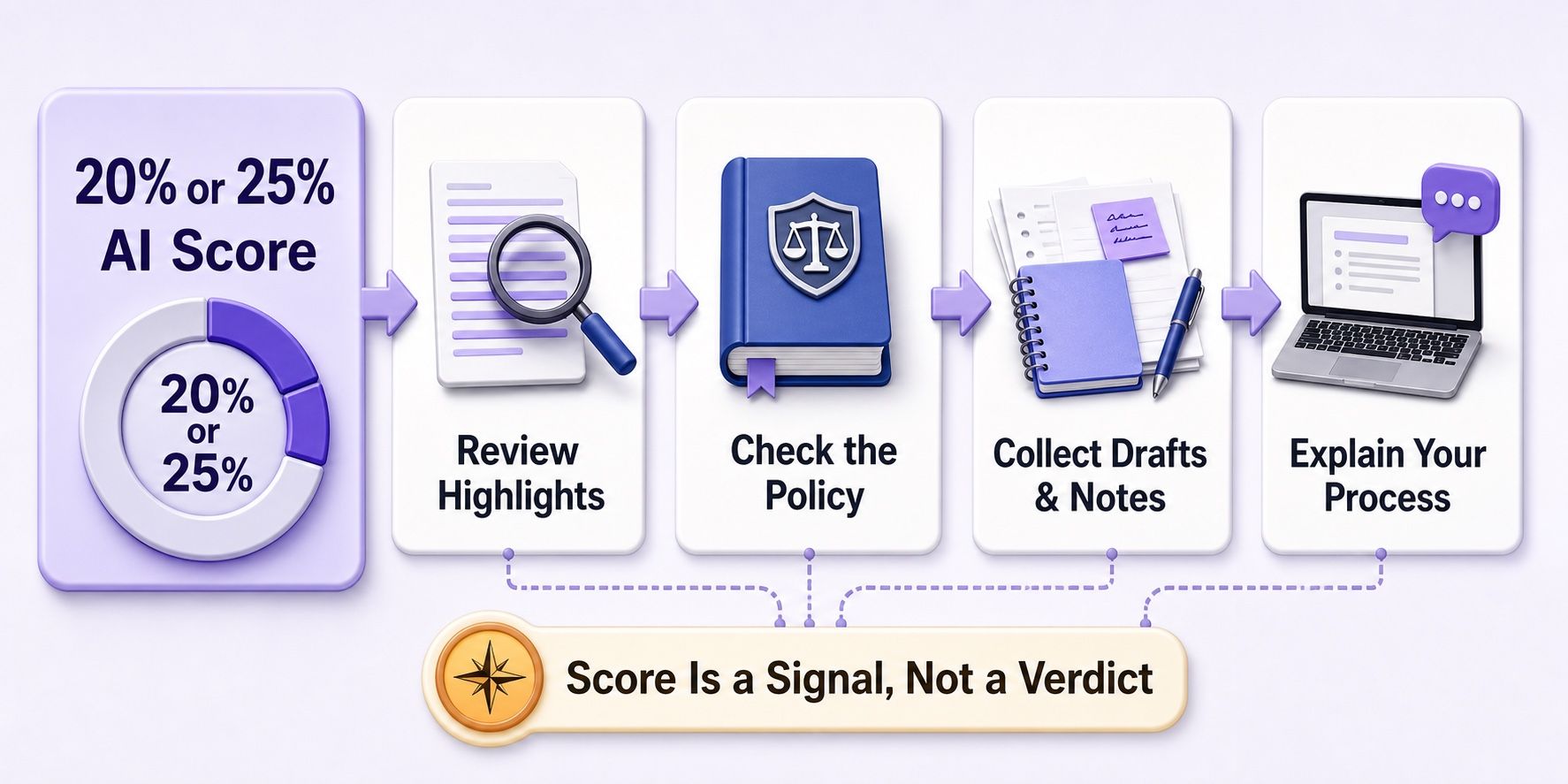
If a highlighted sentence is generic, you may decide to improve it because it is weak writing. Add a real example, clarify the reasoning, or use more precise evidence because those changes make the work better, not because they are tricks for changing a score.
If the review reveals that prohibited AI-generated content was included, return to the assignment requirements. Redo the affected work yourself, disclose the issue when required, and ask for guidance if the correction process is unclear.
Use Lynote to Review AI-Like Passages, Not Chase a Target Score
Lynote AI Detector can provide a preliminary second view of text before you review it manually. It displays AI-generated, mixed, and human-written percentages along with sentence-level highlights, but those results should remain signals rather than proof.
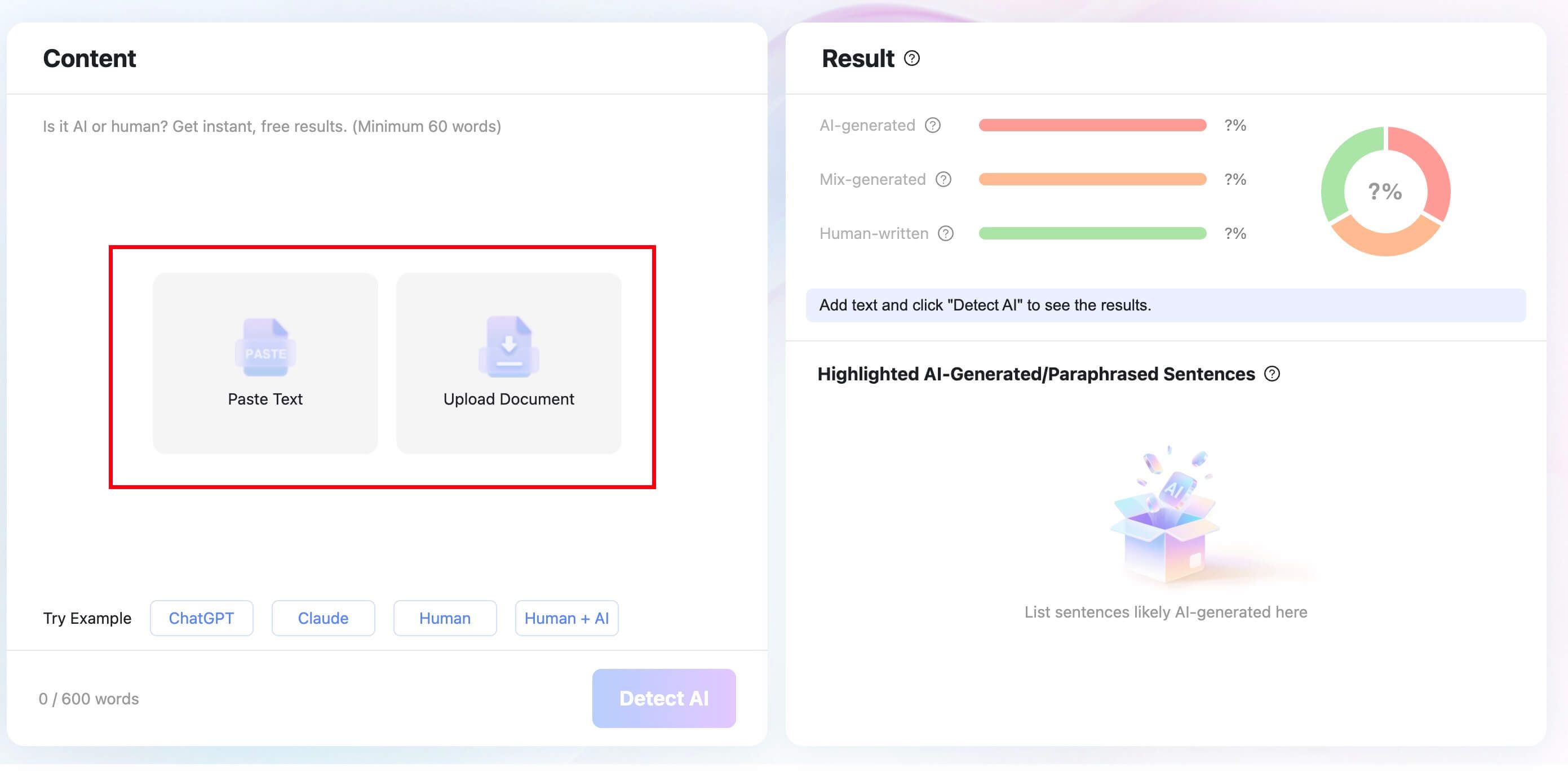
Step 1. Paste Text or Upload a Document
Paste the writing into Lynote AI Detector, or upload a supported DOCX, PDF, or TXT file. Use the same document version you intend to review so the highlighted passages correspond to the text in front of you.
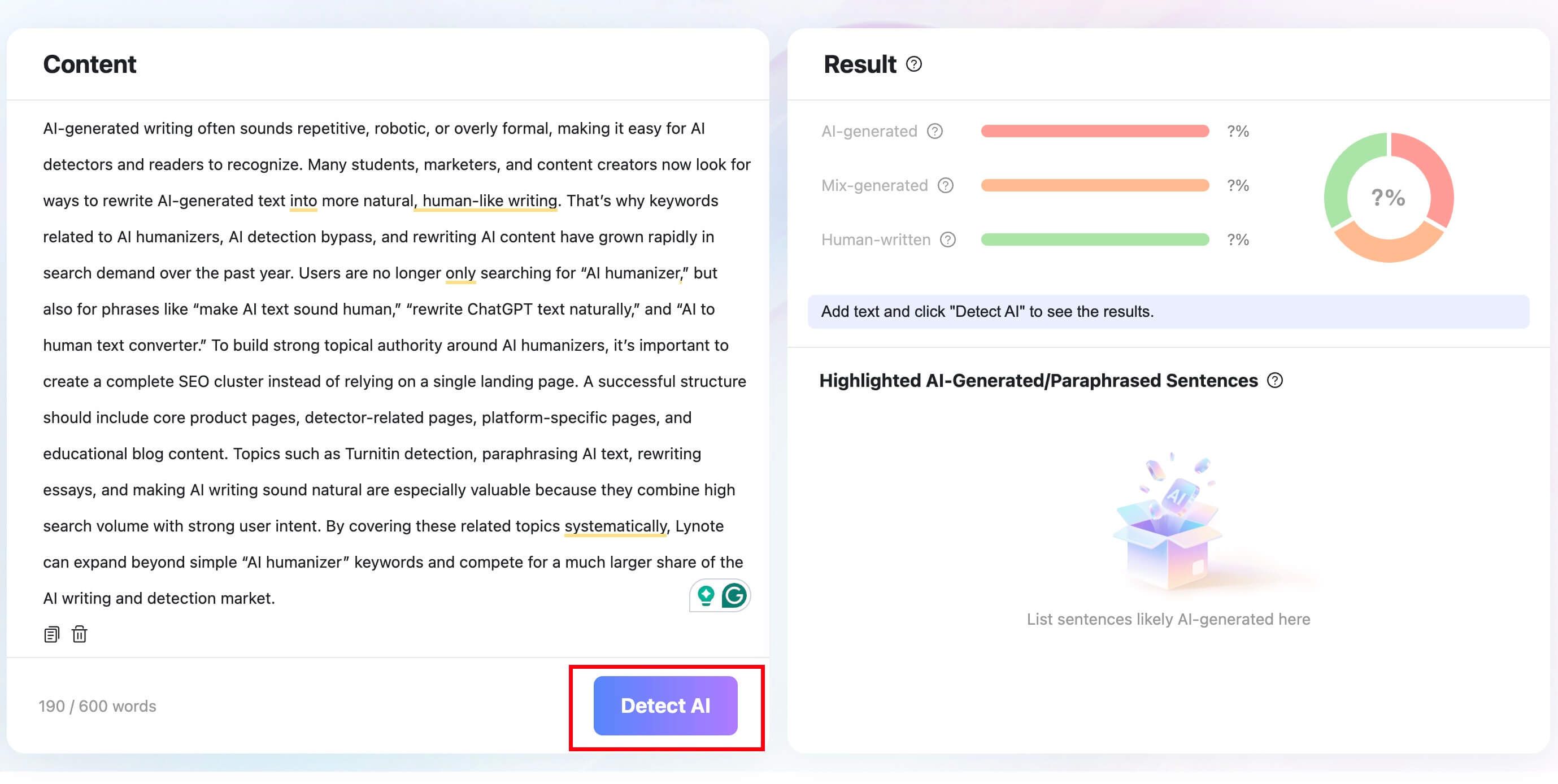
Step 2. Run the Detection Check
Click Detect AI to analyze the writing. Do not choose an acceptable percentage in advance; the purpose is to identify language worth reading more closely.
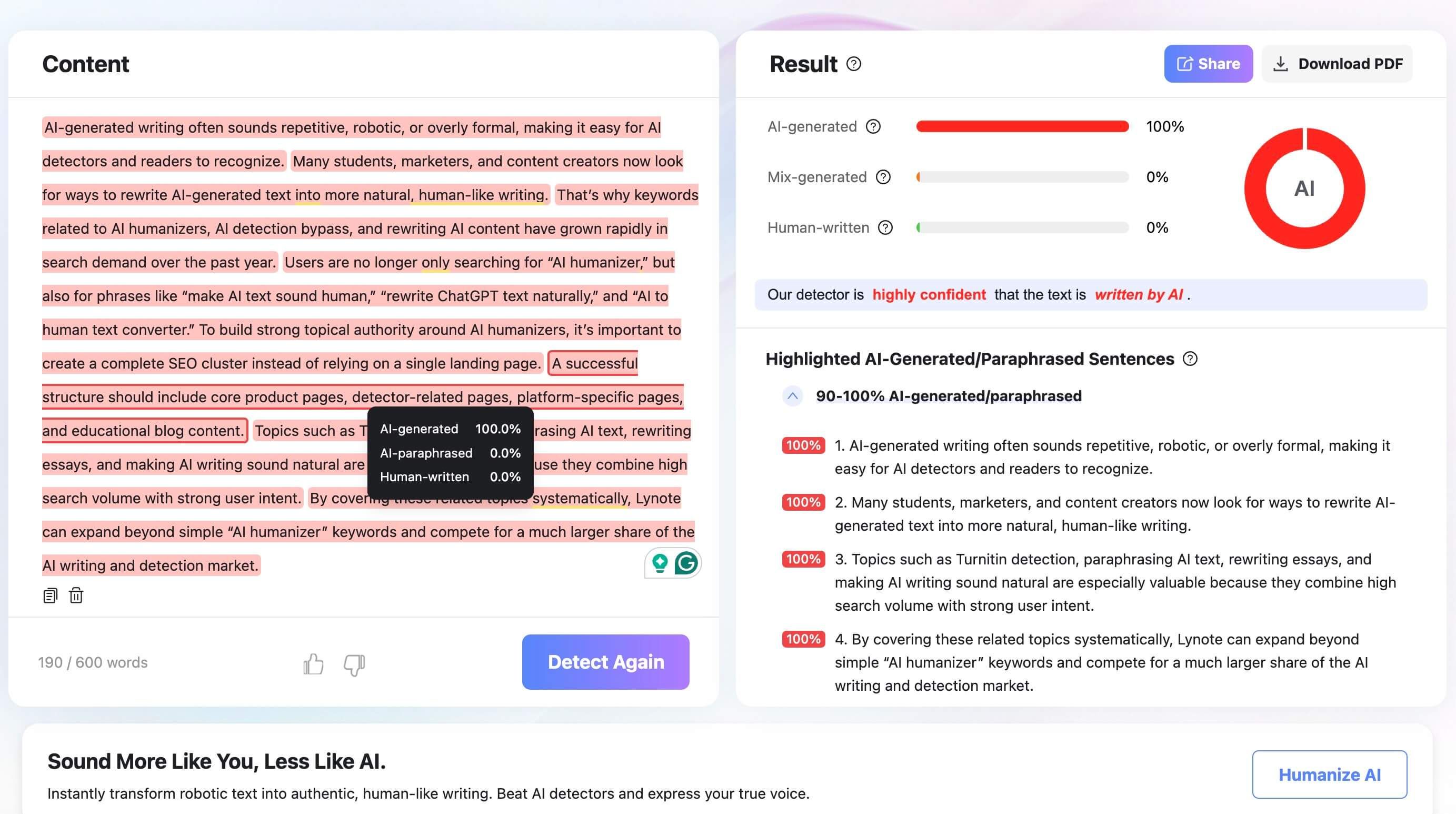
Step 3. Review the Distribution and Highlights
Read the AI, mixed, and human distribution, then inspect the highlighted sentences. Ask whether a passage is formulaic, inconsistent, unsupported, or simply a false positive on authentic writing.

If permitted writing genuinely sounds stiff or generic, Lynote AI Humanizer can help revise clarity and rhythm. Paste the text or upload a PDF, DOC, DOCX, or TXT file, then select Balanced, Focus, or Advanced based on how much rewriting the draft needs.

Review every change against the original. Preserve facts, citations, technical terms, personal examples, and your actual meaning; do not use rewriting merely to conceal prohibited assistance or hit a target score.
Neither Lynote tool can determine your institution's policy. The Detector supports review, while the Humanizer supports permitted revision of work you understand and own.

A Better Standard Than “What Percentage Can I Get Away With?”
The percentage question often hides a more useful one: can the writer defend the work and the process that produced it?
Use this five-question self-audit:
| Question | If yes | If no |
|---|---|---|
| Can I explain every central claim and source? | Continue to factual review | Research and rewrite the unsupported material |
| Does the text reflect my reasoning and voice? | Preserve the authentic language | Replace generic content with your own analysis |
| Was each AI-assisted task permitted? | Check disclosure requirements | Stop and redo prohibited work |
| Did I disclose assistance as required? | Keep the disclosure with the submission | Add the required documentation or ask for guidance |
| Can my notes and drafts show development? | Retain the records | Begin keeping a clearer process for future work |
This standard remains useful when two detectors disagree. It also aligns more closely with what education is supposed to evaluate: understanding, reasoning, communication, and honest participation in the work.
The goal is not to manufacture prose that looks statistically human. It is to produce work that is accurate, permitted, transparent, and recognizably connected to the writer's thinking.
FAQs About Acceptable AI Detection Scores
What is an acceptable AI detection score?
There is no universal acceptable score. The applicable policy and the type of AI use determine acceptability, while the detector result provides only a signal for review.
Is 20% AI detection bad?
Twenty percent is worth examining, but it does not automatically indicate misconduct. Review the highlighted text, policy, actual writing process, drafts, and disclosure before reaching a conclusion.
Is 25% AI detection bad?
A 25% score is not automatically acceptable or prohibited. Its meaning depends on what text was flagged, how the document was created, and which rules apply.
Is any AI allowed in a college essay?
It depends on the context. A course may prohibit, limit, permit, or require AI, while an admissions essay may apply separate own-work and honest-presentation standards.
Does Turnitin allow up to 20% AI?
No. Turnitin's below-20 treatment reflects a higher incidence of false positives and a reporting decision, not permission to include a certain amount of AI-generated writing.
Is an AI score the same as a similarity score?
No. An AI score estimates whether qualifying prose resembles AI-generated or AI-altered writing, while a similarity score identifies text matching indexed sources or submissions.
Can human writing receive a high AI score?
Yes, false positives are possible. Formulaic, technical, translated, short, heavily edited, or second-language writing may require especially careful interpretation.
What should I do if I wrote the essay but it was flagged?
Save the report and original file, review the highlights, collect drafts and notes, verify your citations, check the policy, and ask how the result will be reviewed. Do not rewrite authentic work solely to chase zero.
Can an AI detector prove academic misconduct?
No. A detector cannot establish authorship, intent, permission, or disclosure by itself. Academic misconduct decisions require policy context, supporting evidence, and human judgment.
Should I try to make my AI score 0%?
No detector score can certify originality or compliance. Focus on accurate claims, your own reasoning, permitted tool use, required disclosure, and a writing process you can explain.
Final Answer: Follow the Policy, Not a Percentage Myth
There is no universal answer such as 0%, 10%, 20%, or 25% AI being acceptable. Those numbers are detector outputs, while acceptable use is defined by the relevant academic or application policy.
Twenty percent and 25% should prompt contextual review, not automatic panic or punishment. Look at the passages, the writing process, the permitted tasks, the disclosure, and the evidence connecting the writer to the work.
The most defensible essay is not the one with the lowest score. It is the one that is accurate, explainable, honestly produced, properly disclosed, and supported by drafts and reasoning the writer can stand behind.

Written by Danny
Product Marketing Manager
Danny explains how Lynote features fit real workflows, from everyday productivity to product-led writing use cases. View all articles →