
Can Turnitin Detect QuillBot? What the Report Can Actually Show

Can Turnitin detect QuillBot? Turnitin may flag text that has been heavily paraphrased or rewritten with QuillBot if the final writing still looks AI-like, overly uniform, or too close to another source. But a Turnitin report usually cannot prove from the text alone that QuillBot was the exact tool used.
The important distinction is between a writing signal and tool attribution. Turnitin can help an instructor review suspicious patterns, but it is not a complete record of every website, extension, or rewriting tool involved in a draft.
Quick Answer: Can Turnitin Detect QuillBot?
Yes, Turnitin can potentially flag QuillBot-style paraphrasing. That is especially true when a student uses QuillBot to rewrite AI-generated text, spin a source passage, or smooth a paragraph so heavily that the final result loses the writer's own reasoning.
That does not mean every QuillBot edit is automatically detected. A small grammar fix is different from rewriting a full paragraph, and a detector result should still be interpreted with draft history, citations, assignment rules, and teacher judgment.
What Turnitin Is Actually Looking At
People often say "Turnitin detects QuillBot" as if one report checks everything. In practice, there are several different concerns: similarity matching, AI-writing detection, and AI-paraphrasing signals.
Similarity checking asks whether your text overlaps with existing sources. AI-writing detection asks whether the text resembles generated writing. AI paraphrasing concerns ask whether a passage looks like it was rewritten by a machine after being generated or copied.
| Report or signal | What it checks | What it may suggest | What it cannot prove |
|---|---|---|---|
| Similarity report | Overlap with sources | The draft may rely too closely on existing text | That QuillBot was used |
| AI writing report | AI-like language patterns | Some passages may need review | That every highlighted line is misconduct |
| AI paraphrasing signal | Machine-like rewriting patterns | A passage may have been reworked by AI | The exact rewriting tool |
| Teacher review | Drafts, voice, sources, and process | The writing may not match the student's work | A complete tool history without evidence |
QuillBot matters because it changes wording. But changing wording alone does not always change structure, source dependence, or the kind of polished rhythm that can make a paragraph look AI-assisted.
Why QuillBot-Rewritten Text Can Still Look Risky
QuillBot is designed around paraphrasing and rewriting, so it can change vocabulary quickly. The problem is that a synonym swap does not automatically create original analysis.
A paragraph can still follow the same logic, sentence order, and argument shape after being rewritten. If the original text was AI-generated, QuillBot may simply create a cleaner version of the same AI-like structure.
The risk rises when the rewrite becomes too smooth. Academic writing usually includes friction: source-specific details, uneven drafts, careful qualifications, and claims that connect to the assignment. A heavily paraphrased paragraph can lose that texture.
The other risk is compression. QuillBot can make a paragraph shorter and cleaner, but it may also flatten the difference between an author's claim, your interpretation, and your evidence. To a reader, that can look like a paragraph that has been made more fluent without becoming more intellectually yours.
This is why QuillBot is not just a wording issue. If the original paragraph had weak reasoning, missing citations, or borrowed structure, the paraphrased version may still carry those problems under a new surface.
Can Turnitin Say "This Was QuillBot"?
Usually, no. A Turnitin-style report may show that text appears AI-like or paraphrased, but that is different from proving the exact tool behind it.
QuillBot, ChatGPT, Grammarly AI, Claude, Gemini, and other tools can all produce polished rewrites. Their outputs may overlap in style, so a detector generally cannot identify one named tool with courtroom-level certainty.
Instructors may still ask questions if the draft looks unusual. They may compare the work with earlier writing, check whether sources were actually used, review version history, or ask the student to explain the argument.
QuillBot Use Cases: Lower Risk vs Higher Risk
Not every QuillBot use case carries the same academic risk. The difference is whether the tool is correcting your writing or replacing your thinking.
| QuillBot use case | What changes | Main concern | Safer approach |
|---|---|---|---|
| Fixing a typo or local grammar issue | A small surface error | Usually low if allowed by policy | Keep the original meaning |
| Rephrasing one awkward sentence | Wording and flow | The sentence may sound less like you | Check that the claim is still yours |
| Rewriting a full paragraph | Structure and voice | Authorship becomes less clear | Rebuild the paragraph from notes |
| Paraphrasing a source passage | Source wording | Similarity and citation risk remain | Summarize with citation and analysis |
| Rewriting AI-generated text | AI structure plus paraphrasing | High AI-like pattern risk | Write from your own evidence |
The safest question is not "Will Turnitin catch this?" A better question is "Can I explain this paragraph, its sources, and how I wrote it?"
What to Do if Your QuillBot Rewrite Sounds AI-Like
Do not run the text through another paraphrasing tool as the main fix. That can make the writing smoother without making it more original.
Instead, return to the assignment prompt and your sources. Write a one-sentence claim in your own words, add a source or class detail that supports it, and explain why that evidence matters.
If the assignment is important, keep your notes and drafts. Process evidence is often more useful than trying to argue with a detector score after the fact.
Use Lynote AI Detector as a Second Review Signal
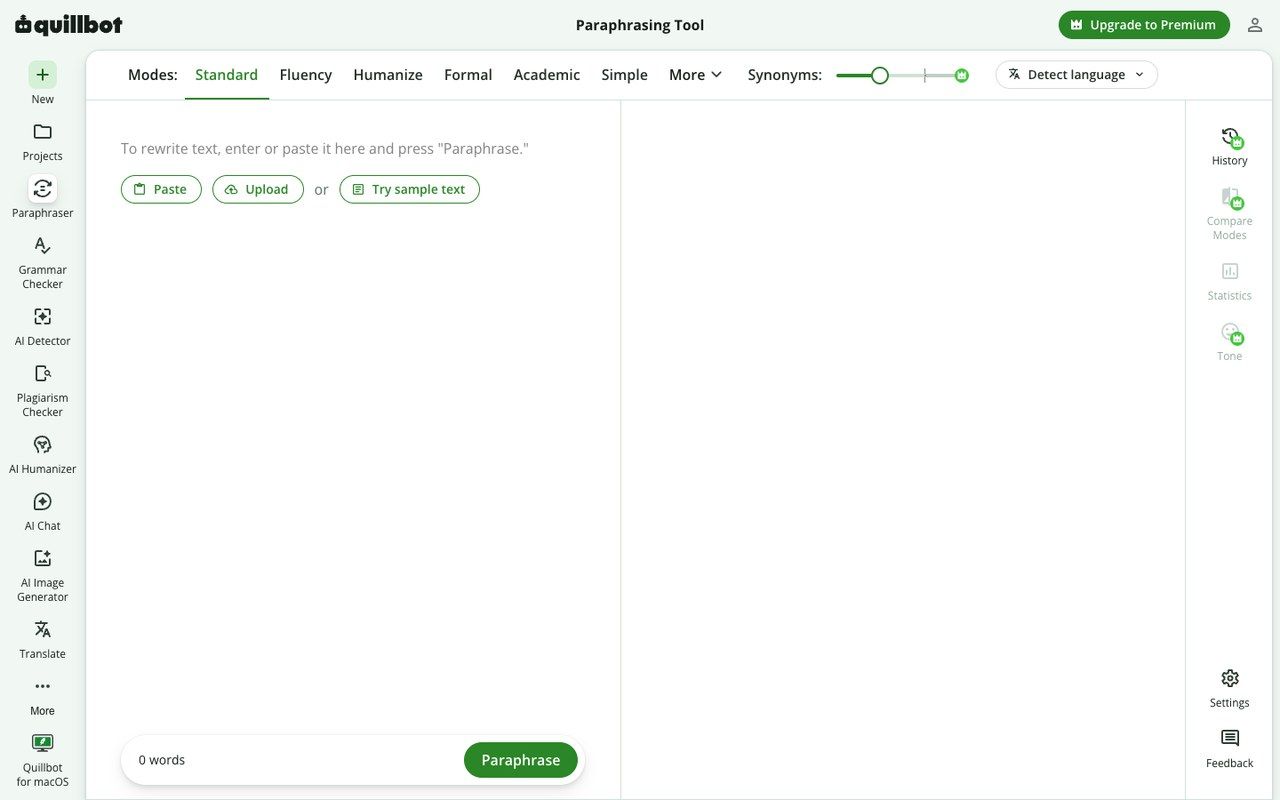
You can use Lynote AI Detector to check whether a QuillBot-rewritten passage still looks AI-like. Treat the result as a revision signal, not proof that Turnitin will or will not flag the text.
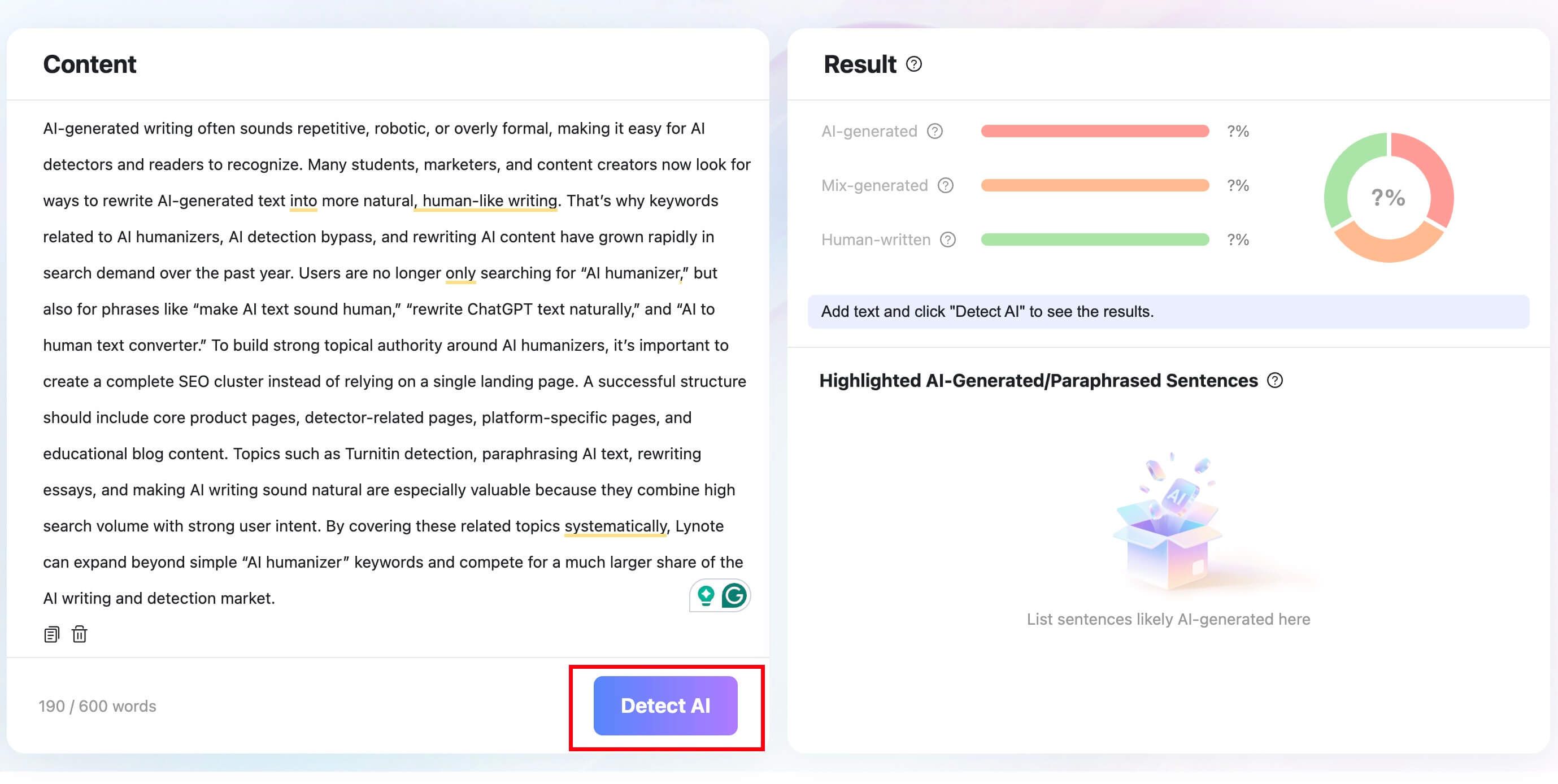
Step 1. Paste Text or Upload a Document
Open Lynote AI Detector and paste the passage you want to review. You can also upload a supported Word, PDF, or TXT document when you need to check a longer draft.
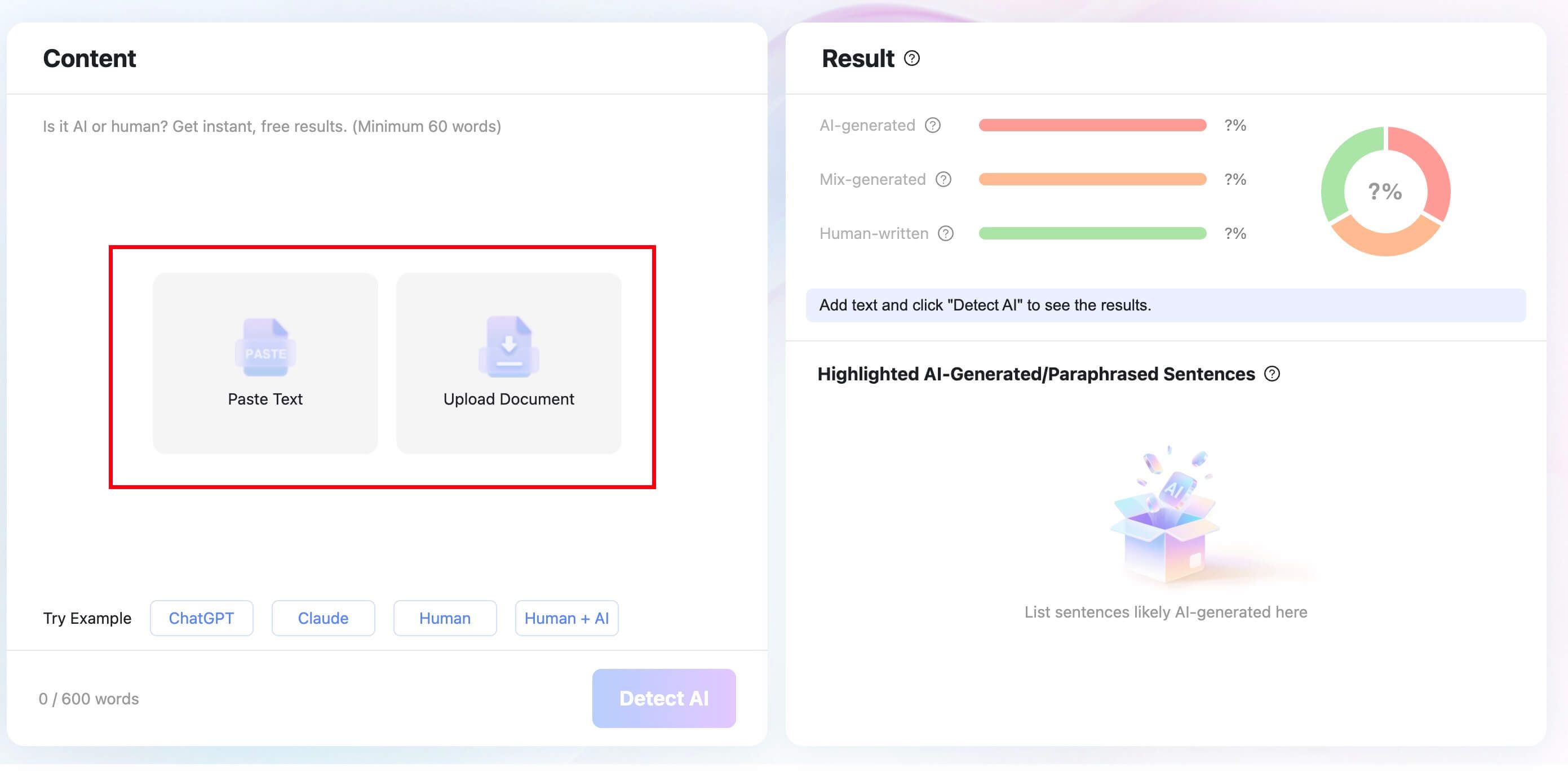
Step 2. Click Detect AI
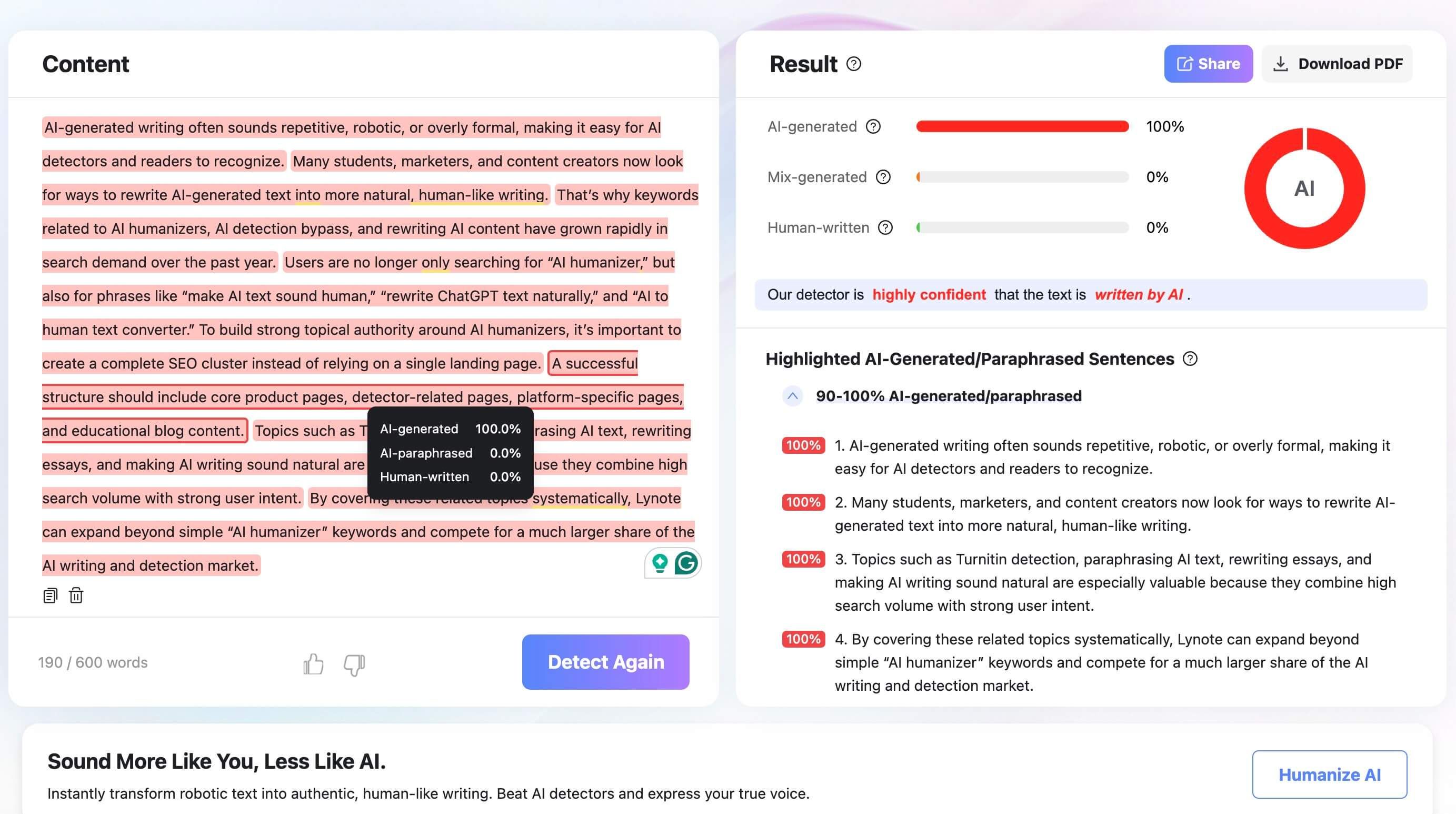
Click "Detect AI" to scan the text. Lynote returns a breakdown of AI-generated, mixed, and human-written signals.
Step 3. Review the Highlighted Sentences
Use the sentence-level highlights to find lines that need clearer sourcing, more specific evidence, or a more natural rhythm. If a sentence is generic, revise the idea itself before polishing the wording.

Why QuillBot Risk Is Different From Ordinary Paraphrasing
Human paraphrasing is not only a change in words. A strong paraphrase usually shows that you understood the source, selected the relevant idea, changed the structure, and connected it to your own argument.
QuillBot can help with wording, but it does not automatically perform that judgment. If you paste a source paragraph and accept a rewritten version, the tool may preserve the same sequence of ideas, the same evidence order, and the same level of distance from the original source.
That matters for both similarity and AI review. Even when the exact wording changes, the paragraph may still look derivative because it follows the original too closely. If the source paragraph was already generated by AI, the rewrite may simply become a second-generation AI-style paragraph.
A better test is to close the tool and explain the idea without looking at the source sentence. If you can explain the claim, name the evidence, and say why it belongs in your assignment, you are closer to real paraphrasing. If you still need the original paragraph next to you sentence by sentence, the rewrite is probably too dependent.
How a QuillBot-Rewritten Paragraph Usually Gives Itself Away
QuillBot-style rewriting often leaves a few recognizable problems. One is synonym inflation: simple words become more formal, but the sentence does not become more precise. Another is balanced but empty phrasing, where every claim sounds careful but none of them point to a specific reading, lecture, dataset, or example.
You may also see source shadowing. The paragraph no longer uses the same words as the source, but it still follows the same outline: definition, explanation, example, conclusion. That can make the writing look clean while the underlying authorship remains unclear.
Another clue is voice discontinuity. A student may write most of an essay in direct, uneven, specific language, then suddenly submit one paragraph with highly polished transitions and abstract phrasing. The issue is not that polished writing is bad. The issue is that a sudden change can make the process harder to trust.
Here is a practical review table:
| Signal in the draft | Why it matters | Stronger revision move |
|---|---|---|
| Synonyms changed but sentence order remains the same | The rewrite may still depend too closely on the source | Rebuild the paragraph around your own claim |
| Generic transitions appear everywhere | The paragraph may sound machine-smoothed | Replace vague transitions with assignment-specific logic |
| Citations sit at the end but evidence is not discussed | The source is present but not integrated | Explain what the cited evidence proves |
| The paragraph is more formal than the rest of the paper | Voice mismatch can trigger review | Revise for consistency with your own writing style |
| You cannot explain why each sentence is included | Authorship is unclear | Cut or rewrite from notes before polishing |
A Stronger Revision Workflow Than Running Another Rewrite
If a QuillBot passage feels risky, the weakest fix is to paraphrase it again. A second rewrite can make the language even smoother while leaving the same structure and weak evidence behind.
Start by extracting the idea, not the sentence. Write one plain claim that answers the assignment prompt. Then add one piece of evidence you can actually explain: a class concept, a source detail, a quote you understand, or a concrete example from your research.
Next, decide what the paragraph needs to do. Is it defining a term, comparing two ideas, explaining a cause, or evaluating a source? Once you know the function, rewrite the paragraph around that job instead of asking another tool to produce a more human-sounding version.
Finally, compare the new paragraph with your earlier draft. If the idea is clearer, the citation is easier to defend, and the voice still sounds like you, the revision is stronger than a surface paraphrase.
What To Keep If Your Work Is Questioned
If an instructor asks about a QuillBot-like passage, process evidence can matter more than debating one score. Keep outlines, rough notes, source annotations, earlier drafts, and comments that show how the paragraph developed.
Do not rely on a screenshot of a low AI score as your only defense. Detector results can vary, and they rarely answer the real authorship question. A writing process record is more persuasive because it shows where the ideas came from and how the final draft changed.
If your school allows some writing assistance, be specific about the type of help. "I used a grammar tool for wording" is very different from "I pasted a source paragraph and accepted a full paraphrase." The more clearly you can describe the boundary, the easier it is to have a fair conversation.
The Bottom-Line Test Before Submitting
Before submitting a QuillBot-edited draft, read each paragraph and ask three questions. Did I create the claim? Can I explain the evidence? Does this sound consistent with the rest of my writing?
If the answer is no, the paragraph needs more than humanized wording. It needs better thinking, clearer sourcing, and a revision pass that starts from your own understanding.
FAQs About Turnitin and QuillBot
Can Turnitin detect QuillBot paraphrasing?
Turnitin may flag QuillBot-paraphrased writing if the final text looks AI-like, overly rewritten, or too close to a source. It usually cannot prove QuillBot was the exact tool used from the text alone.
Can QuillBot bypass Turnitin?
No tool should be treated as a reliable way to bypass Turnitin. Paraphrasing can change wording, but it may leave source dependence, AI-like structure, weak citations, and voice mismatch intact.
Does Turnitin detect QuillBot Premium?
The risk is not only about the account tier. A premium rewrite can still look machine-like if it changes surface wording without adding original reasoning, source engagement, or a natural writing process.
Is using QuillBot considered cheating?
It depends on the assignment and school policy. Light proofreading may be allowed in some contexts, while submitting rewritten source passages or AI-generated paragraphs as your own work can violate academic rules.
What should I do if Turnitin flags my QuillBot rewrite?
Review the highlighted passages, gather your drafts and notes, and revise the work from your own understanding. If the assignment is under review, follow the school's process and be clear about what help you used.
Final Verdict
Turnitin can flag QuillBot-style writing when the final text still looks AI-like, paraphrased, or weakly sourced. But the report is a signal, not proof that one named tool wrote the paper.
The safest path is to use writing tools only within the rules, preserve your own reasoning, cite sources clearly, and keep enough process evidence to explain how the work was created.
Written by Janet L. Harris
AI Writing Specialist
Janet reviews AI detectors and humanization tools, with a focus on accuracy, limitations, and responsible use. View all articles →